
Register Your interest
Call Claire 0431 180 783 |
Email claire@cholangio.org
Including Steve Holmes & Professor Phillip Baird
Register Your interest
Call Claire 0431 180 783 | Email claire@cholangio.org
Including Steve Holmes and Professor Phillip Baird
Your Next Steps Start Here
Just diagnosed with Bile Duct Cancer also known as Cholangiocarcinoma?
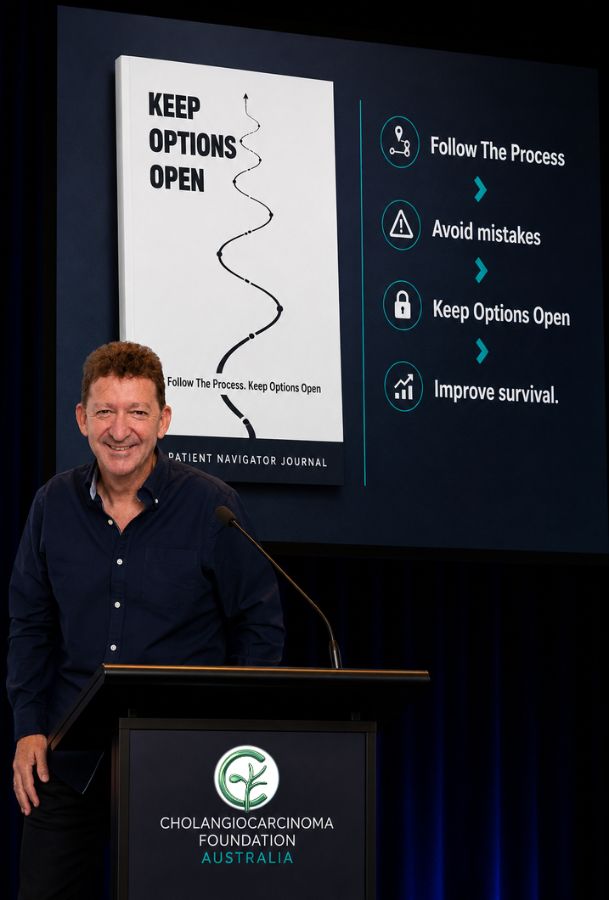
Follow The Process ➤ Avoid Mistakes ➤ Keep Options Open ➤ Improve Survival.
Cholangiocarcinoma Foundation Australia is a patient-led bile duct cancer response platform helping patients and caregivers understand earlier, navigate more effectively, and preserve or potentially expand treatment options while they still exist.
➤ Understand ‘The Gap’
Most bile duct cancers are diagnosed late.
By the time a patient receives their diagnosis, many options have already been lost.
As a newly diagnosed patient, you do not know what you do not know.
Yet you must.
And as quickly as possible.
Cholangiocarcinoma does not wait for your understanding to arrive.
It continues.
And your options continue to be silently lost.
When understanding comes earlier, options are preserved.
When options are preserved, survival opportunities increase.
That is why we developed a process built from lived experience.
Follow The Process ➤ Avoid Mistakes ➤ Keep Options Open ➤ Improve Survival.
Everything we build is designed to help today’s patients preserve and expand their options now.
That is our first responsibility.
Everything else is secondary to that.
That is why we exist.
This is the gap.
The gap between diagnosis and understanding.
The gap where many options are lost before they are realised.
We work to close that gap by building systems that turn understanding into earlier action, better decisions, stronger responses, and more opportunities for survival.
But it does not end there.
To improve survival, we must go deeper.
In fact, upstream of the diagnosis itself.
The Cure Is In The Cause
Find the cause.
Accelerate the cure.
Improve today’s patient survival now.
Prevent tomorrow’s patients.
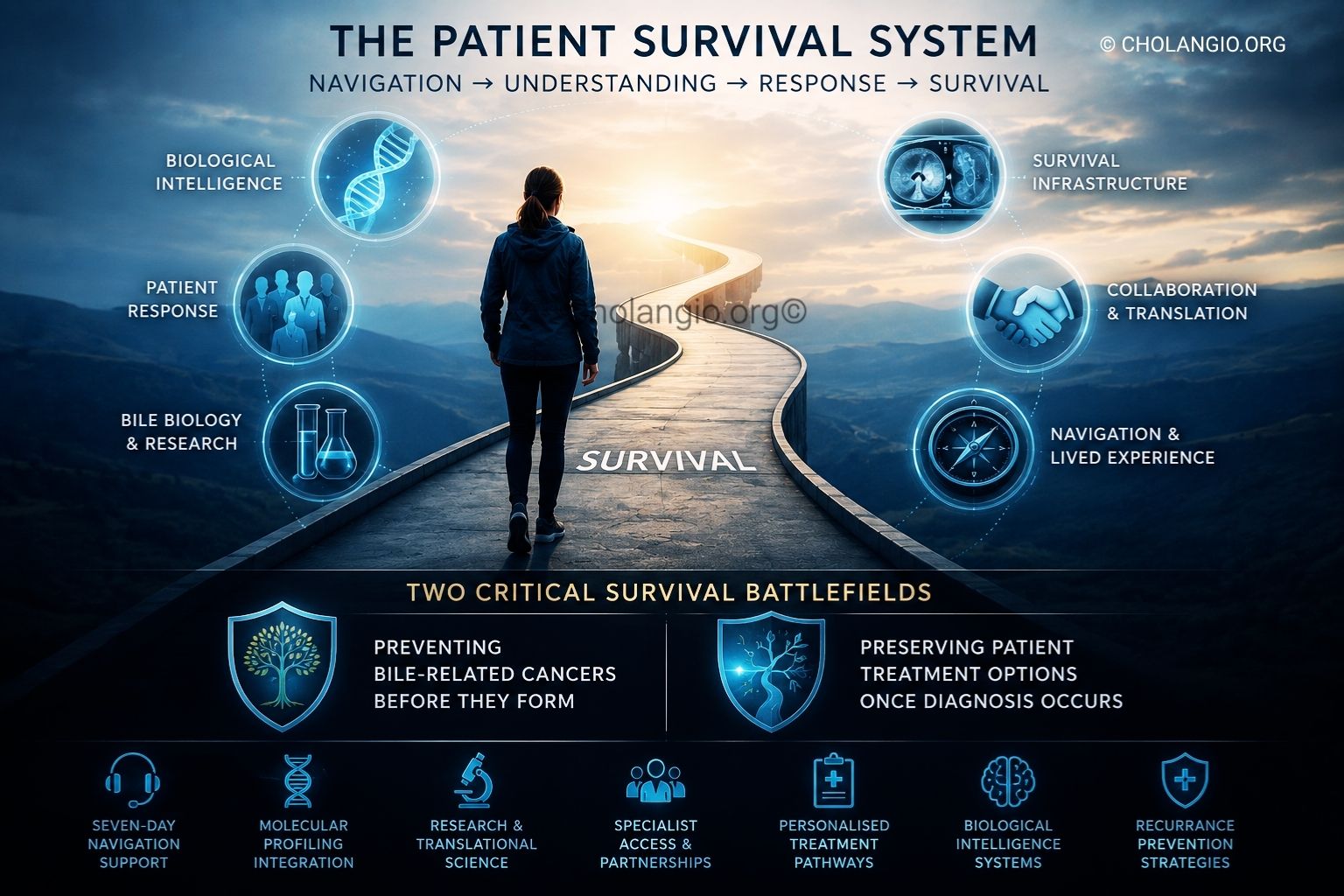
The Patient Survival System
Diagnosis → Orientation → Understanding → Response → Survival
Treatment is critical, but it is only one component of a cholangiocarcinoma response.
After diagnosis, patients need immediate orientation, clearer understanding, and faster action to preserve treatment options.
The Foundation exists to preserve opportunities for today’s patients now, while building the knowledge required to prevent future cases.
The system works across two survival priorities:
Improve today’s patient survival, now.
Prevent tomorrow’s patients.
Understand
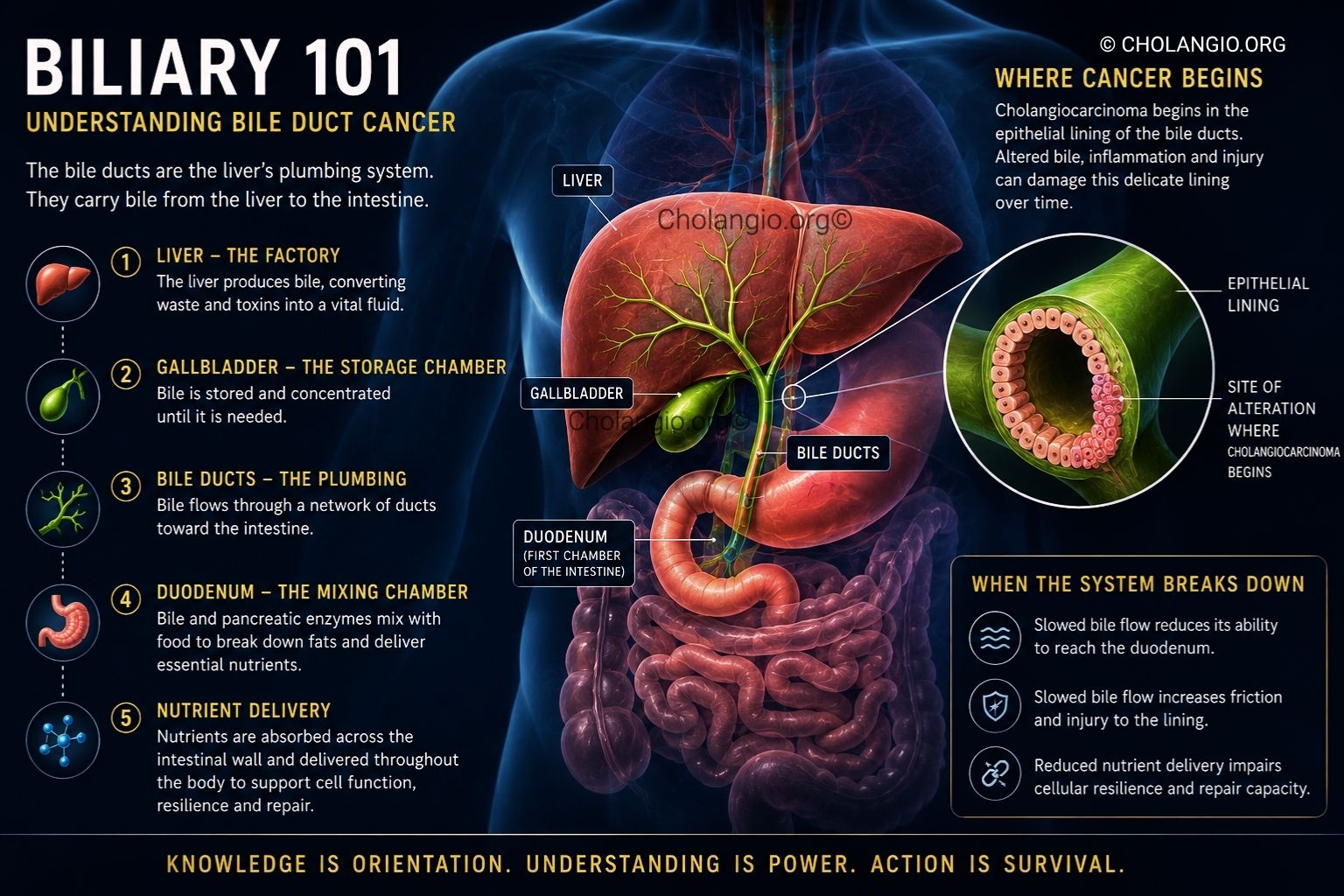
The Biliary System
Understanding → Effective Response
Many patients understand where their tumour is located. Few understand the biological conditions and failures that made it possible.
Yet it is within those conditions and failures that the disease begins, progresses, and shapes what happens next.
Most patients eventually ask three questions:
- Why did I get this cancer?
- Are my family at risk?
- Is there anything important I do not know yet?
Understanding the conditions that made cancer possible provides advantages.
Why
This Foundation Exists
I lost my younger brother Graeme to cholangiocarcinoma.
Two years later, I received the same diagnosis.
After enduring 25 hours of life-threatening surgeries, I still rapidly progressed to a late-stage 4 setting with just weeks to live.
Although genomic profiling was very new at the time, it identified that I had a mutation that matched a new clinical trial called KEYNOTE-158.
When I was diagnosed just six months earlier, that opportunity did not exist.
It led to a complete response. One of the fastest ever recorded from such a late-stage setting in any cancer.
That experience exposed the gap between diagnosis and understanding, the space where options are lost before they are ever known.
This Foundation was built to close that gap.
But it did not end there. To improve survival, we must go deeper, upstream of the diagnosis itself.
The cure is in the cause.
Find the cause. Accelerate the cure.
Improve today’s patient survival now.
Prevent tomorrow’s patients.
After diagnosis, most patients ask three questions:
Why did I get this cancer?
Can I beat it?
Are my family at risk?
What patients need most immediately after a bile duct cancer diagnosis is orientation:
What matters now?
What are my next steps?
Earlier understanding helps preserve options, and preserved options create opportunities for survival.
That reality shaped everything we built.
This Foundation exists to help patients understand earlier, respond more effectively, and preserve opportunities while they still exist, while working to understand what makes cholangiocarcinoma possible in the first place.
Newly diagnosed patients and their families are our heroes. The Foundation focuses on providing them with the ladders they need to climb out and survive.
“Just yesterday, I was a person. Today I am a patient. I must become the best patient I can be, so that I can become that person again.”
That was a thought that flashed through my mind. I am still not sure why it did, but I wrote it down.
Looking back, writing it down gave it life.
That was the moment I shifted from reacting to responding.
Steve Holmes

Why This Foundation Exists
I lost my younger brother Graeme to cholangiocarcinoma.
Two years later, I received the same diagnosis.
After enduring 25 hours of life-threatening surgeries, I still rapidly progressed to a late-stage 4 setting with just weeks to live.
Although genomic profiling was very new at the time, it identified that I had a mutation that matched a new clinical trial called KEYNOTE-158.
When I was diagnosed just six months earlier, that opportunity did not exist.
It led to a complete response. One of the fastest ever recorded from such a late-stage setting in any cancer.
That experience exposed the gap between diagnosis and understanding, the space where options are lost before they are ever known.
This Foundation was built to close that gap.
But it did not end there. To improve survival, we must go deeper, upstream of the diagnosis itself.
The cure is in the cause.
Find the cause. Accelerate the cure.
Improve today’s patient survival now.
Prevent tomorrow’s patients.
After diagnosis, most patients ask three questions:
Why did I get this cancer?
Can I beat it?
Are my family at risk?
What patients need most immediately after a bile duct cancer diagnosis is orientation:
What matters now?
What are my next steps?
Earlier understanding helps preserve options, and preserved options create opportunities for survival.
That reality shaped everything we built.
This Foundation exists to help patients understand earlier, respond more effectively, and preserve opportunities while they still exist, while working to understand what makes cholangiocarcinoma possible in the first place.
Newly diagnosed patients and their families are our heroes. The Foundation focuses on providing them with the ladders they need to climb out and survive.
“Just yesterday, I was a person. Today I am a patient. I must become the best patient I can be, so that I can become that person again.”
That was a thought that flashed through my mind.
I am still not sure why it did, but I wrote it down.
Looking back, writing it down gave it life.
That was the moment I shifted from reacting to responding.
Steve Holmes