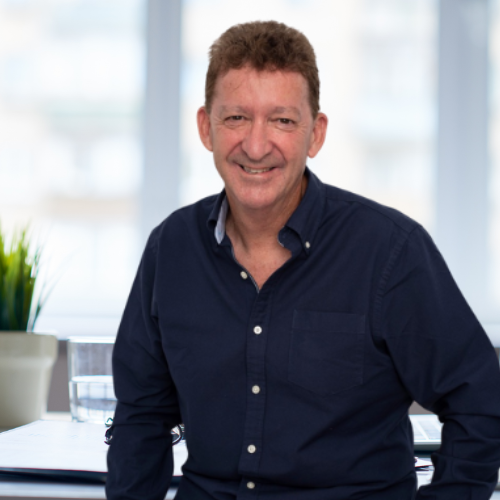
Steve Holmes CEO Profile
Steve Holmes
Terminal Stage IV Cholangiocarcinoma Patient | Co-Founder, Cholangiocarcinoma Foundation Australia
Achieved one of the fastest documented complete responses ever recorded, then turned what that survival revealed into systems for Earlier Understanding and Earlier Right Action, creating more curative opportunity, extending life and preventing tomorrow’s diagnoses.
CURE MORE. EXTEND LIFE. PREVENT MORE.
The path: Survival → Understanding → Systems → Patient outcomes.
About Steve
Steve Holmes works at the intersection of lived cancer survival, patient experience, cancer biology and systems thinking.
He arrived there by necessity.
An Exceptional Survival
Steve and his younger brother Graeme were both diagnosed with cholangiocarcinoma. Graeme died.
Steve later progressed to late-stage Stage IV disease, with widespread metastases across his liver and lungs.
In 2017, tumour profiling opened an opportunity to enter the KEYNOTE-158 immunotherapy trial .
Within three days of his first infusion, his pain disappeared and his breathing and function began to return. Nine weeks later, scans confirmed a complete response.
But survival became the beginning of his work, not the end of his story.
Putting Survival To Work
Patients and families began contacting Steve and his wife Claire after hearing about his response.
At first, they shared what they had learned. But something quickly became clear. People did not simply need a survival story. They needed a path.
Steve and Claire began turning their experience into something other families could use: a way to understand the disease, respond earlier, avoid preventable mistakes and keep options open.
They founded Cholangiocarcinoma Foundation Australia and remained on the patient battlefield. Over the years that followed, Steve worked directly alongside thousands of patients and families confronting cholangiocarcinoma.
He saw where understanding arrived too late, where patients lost options, and where surgery, oncology, molecular profiling, clinical trials, interventional treatments and specialist expertise connected well, or failed to connect.
Those repeated observations became lived expertise and changed the questions Steve was asking.
Curative Opportunity
Cholangiocarcinoma already has an established curative pathway: surgery.
That changes the starting question.
Steve's work begins with two connected objectives: get more patients to surgery while surgery is still possible, and expand what surgery itself can cure.
The first requires earlier diagnosis, earlier specialist surgical assessment, consistent application of current guidelines, second opinions when needed, and protecting curative options from being unintentionally closed.
The second requires strengthening surgical capability itself, including expertise in technically difficult disease, greater consistency between centres and innovation around the pathway that already produces almost all curative outcomes.
Systemic and other treatments can also support that pathway, including reducing recurrence risk and, in selected patients, creating an opportunity to reach surgery.
The Full Cancer Arc
Working alongside patients made one thing increasingly clear: improving response after diagnosis was only part of the problem.
The deeper question was what happened before diagnosis.
Steve began working backwards through the cancer arc, from treatment and survival to tumour biology, bile composition, bile flow, cellular injury and the conditions of cause that support cancer formation across the biliary tract.
That changed the scope of the work.
The objective became not only to help today’s patient survive, but to understand enough of the pathway to create earlier detection and prevent tomorrow’s diagnoses.
Earlier Understanding
One path started with survival and worked forward through thousands of patients.
The other started with cancer and worked backwards towards its conditions of cause.
Ultimately, they met in the same place.
Earlier Right Action delivers it.
Patient-Led
Medicine, research and advocacy each bring essential expertise.
The patient and family carry the whole journey, and they carry the consequence.
That gives lived experience a different kind of value: the ability to see where decisions connect, where gaps form, where options are lost and where earlier understanding could change what happens next.
Steve's work has been to turn that lived experience into shared capability, so patients and families can better understand the full arc, engage with specialist expertise and take Earlier Right Action.
Selected Work
Co-founded and leads Cholangiocarcinoma Foundation Australia, building a patient-led response system that turns lived experience into earlier understanding, earlier right action, greater curative opportunity and prevention.
Architect of a patient-led survival system that turns lived experience, repeated patient observations and specialist expertise into shared capability, Survival Intelligence and Earlier Right Action for the next patient.
Author and creator of the patient response journal that turns diagnosis into a step-by-step pathway for earlier understanding, better decisions, keeping options open and Earlier Right Action.
Co-author contributing to the national consensus effort to improve consistency and evidence-based care across diagnosis, surgery, molecular profiling, treatment and follow-up.
Co-author of the Australian review defining best-practice recommendations around major areas of clinical controversy, including biopsy, liver transplantation and biliary stenting.
Co-author of the national Delphi process establishing consensus clinical indicators for optimal, evidence-based biliary tract cancer care.
Focused upstream on bile composition, bile flow and cellular injury to identify the conditions of cause that support cancer forming across the biliary tract, enabling earlier detection and prevention.
Leads multidisciplinary research collaborations bringing together senior clinicians, gastroenterologists, cytologists and researchers to investigate bile composition, bile flow, cellular injury and the conditions of cause, while driving the establishment and research direction of a dedicated bile bank.
Initiates and develops collaborations with clinicians, researchers, funders and industry, connecting patient-derived questions and insight to research priorities, funding decisions, pharmaceutical programs and new initiatives across Australia, New Zealand and internationally.
Architect and facilitator of patient and caregiver forums that connect lived experience with specialist clinical expertise, creating earlier understanding, stronger patient capability and Earlier Right Action.
Further Reading
Explore Steve Holmes' Stage IV cholangiocarcinoma survivor story , his personal website , or the work of Cholangiocarcinoma Foundation Australia .
Steve did not survive simply to tell his story.
He survived, then put that survival to work.