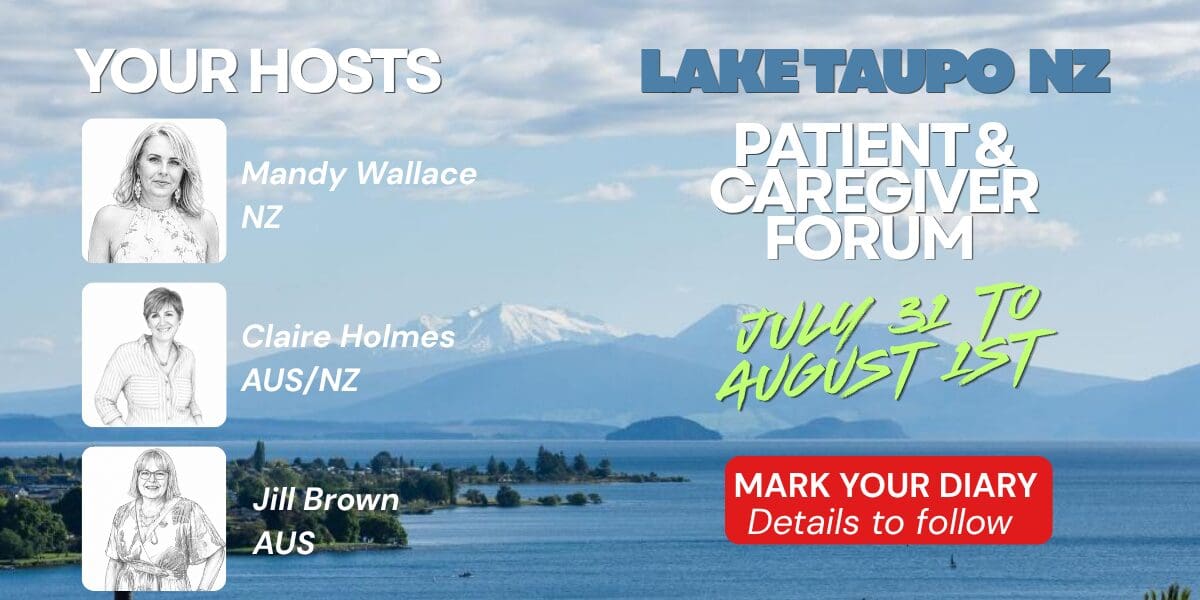
Register Your interest
Call Claire 0431 180 783 |
Email claire@cholangio.org
Including Steve Holmes & William Taing
Register Your Interest
Call Claire 0431 180 783 | Email claire@cholangio.org
Including Steve Holmes and Willian Taing
Your Next Steps Start Here
Just Diagnosed With Bile Duct Cancer, Also Known As Cholangiocarcinoma?
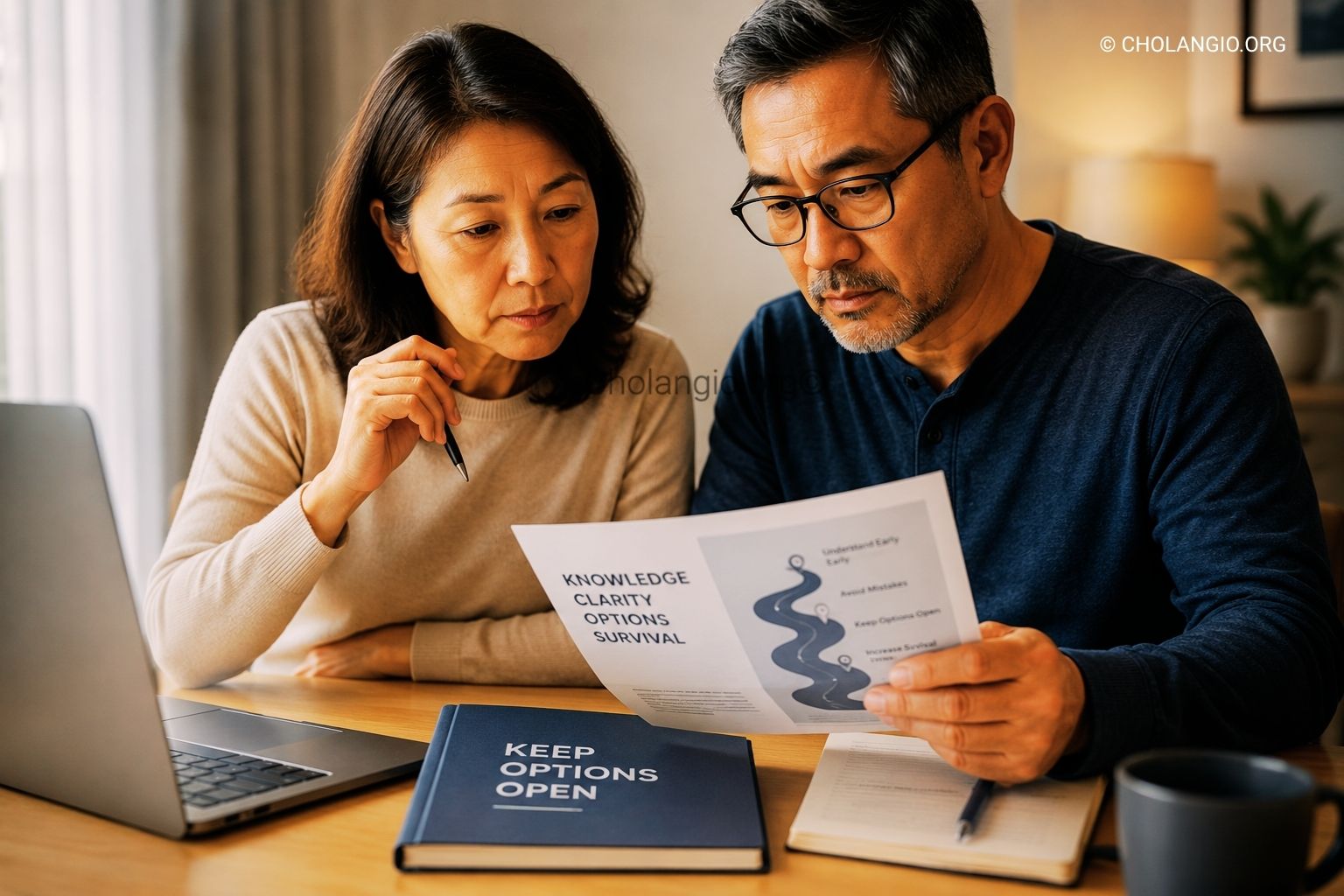
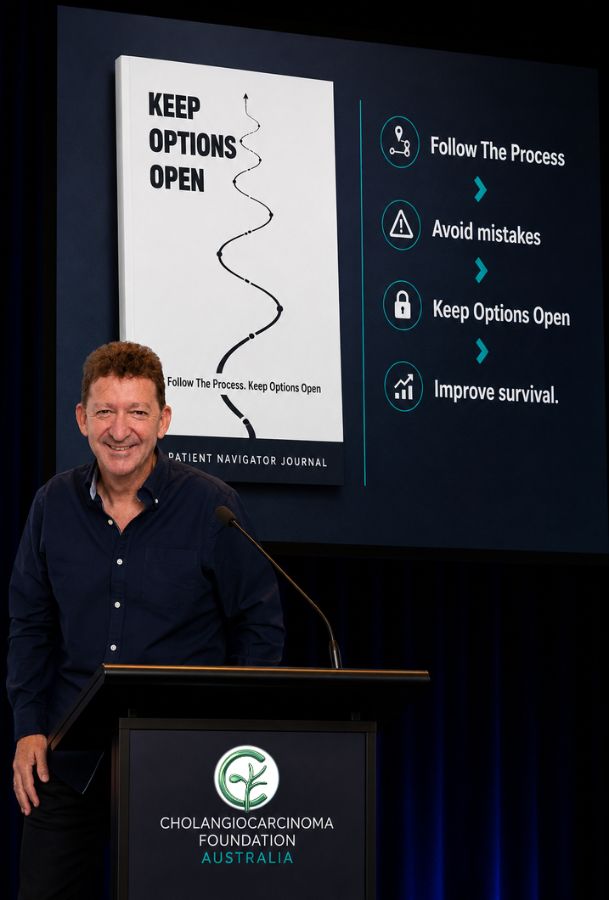
Follow The Process ➤ Gain Earlier Understanding ➤ Avoid Common Mistakes ➤ Keep Your Options Open ➤ Improve Survival.
Cholangiocarcinoma Foundation Australia is a patient-led foundation that turns lived experience into Earlier Understanding.
We help patients understand earlier, act sooner, and improve survival now.
We help their families understand cause earlier, so they do not become tomorrow’s patients.
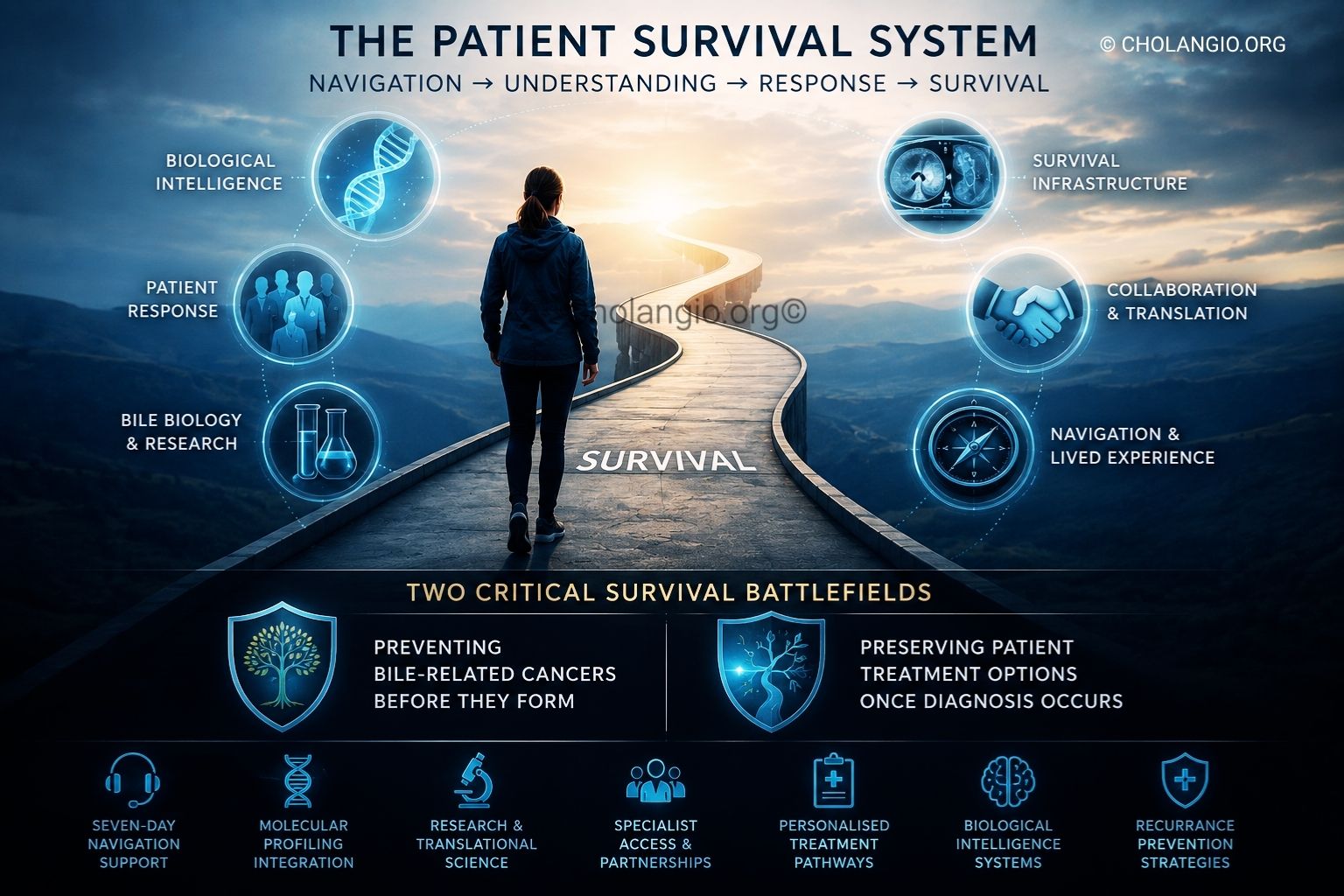
Patient Survival System
Diagnosis ➤ Orientation ➤ Earlier Understanding ➤ Action ➤ Survival
Treatment is critical, but it is only one part of an effective cholangiocarcinoma response.
After diagnosis, patients need immediate orientation, clearer understanding, and earlier action to keep options open.
The Patient Survival System helps patients and families move from diagnosis to Earlier Understanding, then turn that understanding into stronger survival action.
It serves two priorities:
➤ Improve today’s patient survival now
➤ Help prevent tomorrow’s diagnosis
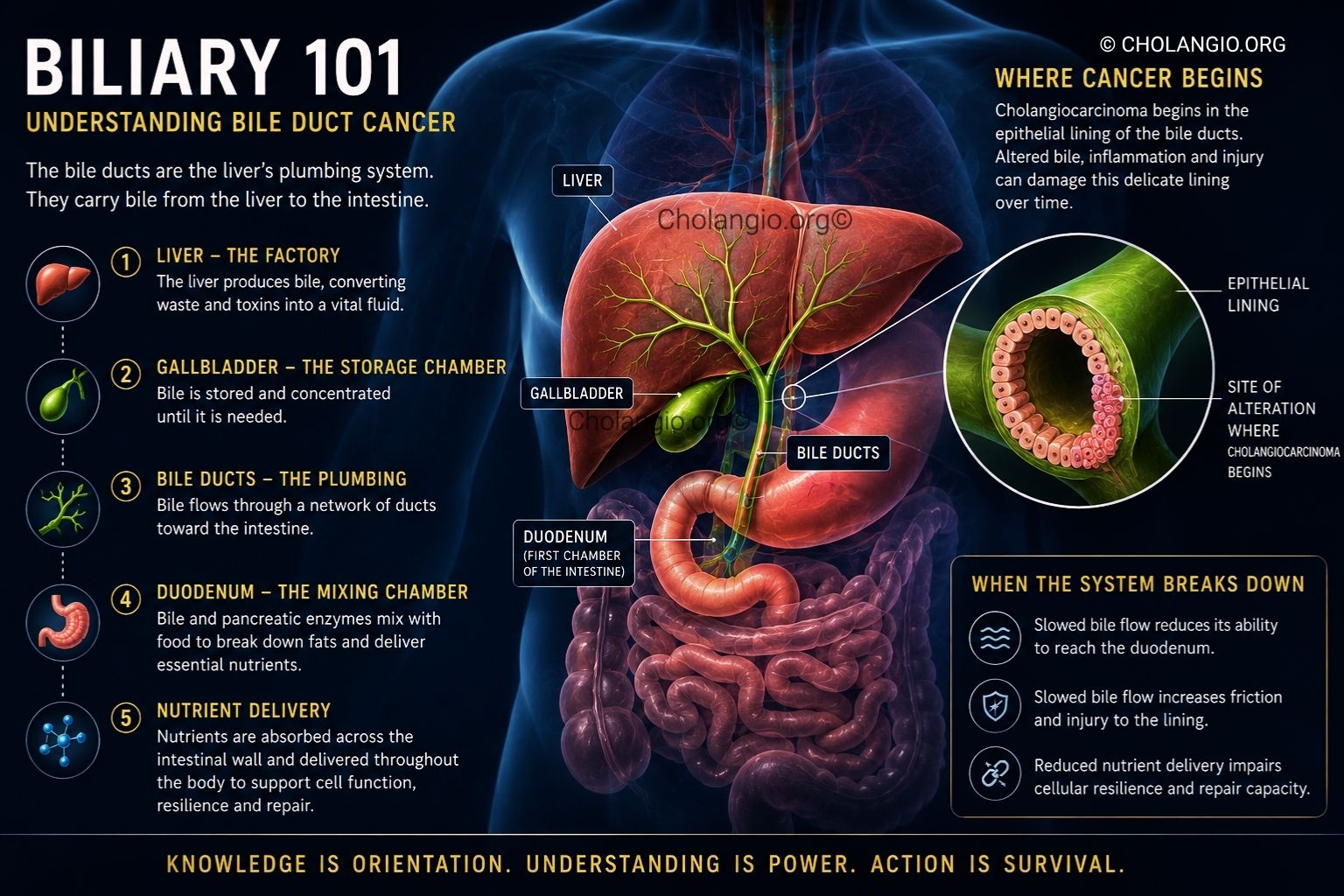
Understand
The Biliary System
Understanding ➤ Drives Effective Response
Many patients understand where their tumour is located.
Few understand the biological conditions and failures that made it possible.
Yet it is within those conditions and failures that the disease begins, progresses, and shapes what happens next.
Most patients eventually ask three questions:
- Why did I get this cancer?
- Are my family at risk?
- What can I do to help beat this?
Understanding what made cancer possible helps patients respond earlier, protect their families, and keep more options open.
Why
This Foundation Exists
From our own experience with bile duct cancer, Claire and I came to recognise two silent gaps driving this cancer and its poor outcomes.
The first gap is between diagnosis and understanding how to respond to it.
The second gap is between its cause and diagnosis.
The common failure point is the same.
Late or no understanding.
The Hero In The Hole
Picture this.
A hero is in a hole. They need a guide with a ladder.
Their family needs to understand what caused the hole, so others do not fall in.
In this story:
- The hero is the patient.
- The hole is the diagnosis.
- The guide is lived experience with Earlier Understanding.
- The ladder is the process born of lived experience and understanding.
Today’s newly diagnosed patient needs an experienced guide with the right ladder, so they can climb out.
Their family needs a guide who understands the cause, so they can act earlier and help prevent others from falling into the same hole.
Patient → ladder → response.
Family → cause → prevention.
Earning Lived Experience
I lost my younger brother Graeme to cholangiocarcinoma in 2014. Then, two years later, I fell into the same hole.
After 25 hours of life-threatening surgeries that were considered successful, I quickly progressed to stage 4 disease, with large tumours across my liver, under my ribcage, and cpmpletely covering both lungs, leaving me with only weeks to live.
Genomic profiling was very new at the time, but it identified a mutation in my tumour that matched me to a new clinical trial, KEYNOTE-158.
When I was diagnosed just six months earlier, that opportunity did not exist.
That match, and our decision to act on it immediately, led to a complete response from a very late-stage setting.
Our experience had exposed the power of Earlier Understanding and effective action.
It also exposed how easily survival options can be missed before they are ever known.
Earlier Understanding
Earlier Understanding became the difference between options seen and options lost.
Claire and I could not walk away from what we had learned, nor from the unexpected responsibility it had handed to us.
Having just defeated cholangiocarcinoma, and against all advice, we took it on again. This time, however, we would build an organised force against it, yet the logic bluntly pointed out that doing so would completely drain our resources.
But just as we had done in our unwinnable battle with ‘Cholangio the Beast’, we defiantly dug in anyway. Now armed with lived experience, a David versus Goliath mindset, and slingshot in hand, we began building a foundation that would help today’s patients do the same.
Building A Foundation
We built a patient-led foundation with three clear objectives:
- Today’s Patient Survival, Now, Today. Execute what works and what is possible right now. Eliminate all distractions to that.
- Prevent Tomorrow’s Patients, Today. Bring an understanding of cause to families earlier, so they do not become tomorrow’s newly diagnosed patients.
- Build a Culture that is a Survival System in itself. A powerful community understanding focused entirely on active survival execution over advocacy.
Hence, our foundational model is built on survival execution, not advocacy.
That was a very tough line in the sand for a patient and caregiver to draw.
We knew from experience that effective advocacy and awareness would always follow what works, not the other way around.
While both have their part to play, in a crisis, funding advocacy and awareness over active execution is letting the tail wag the dog.
Every day is a crisis for a patient and their family diagnosed with cholangiocarcinoma and that is what we must all turn up for every day.
It was a focus that had been poorly understood and missing in this fight.
So we decided to be absolute about it.
Today’s survival and tomorrow’s prevention are what we execute, now, today, every day until it is done.
That is why we focus and fund survival execution over advocacy.
Claire and I will do now, today, what works and what is possible.
We will carve out a survival pathway from lived experience and biological intelligence, clearing a path through Cholangiocarcinoma’s conditions of cause, and the many gaps and traps that wear down an effective response.
A path of earlier understanding, something we had desperately needed.
A path that would inspire patients, families, supporters, and their communities to improve on, to rally behind.
Steve
Why This Foundation Exists
From our own experience with bile duct cancer, Claire and I came to recognise two silent gaps driving this cancer and its poor outcomes.
The first gap is between diagnosis and understanding how to respond to it.
The second gap is between its cause and diagnosis.
The common failure point is the same.
Late or no understanding.
The Hero In The Hole
Picture this.
A hero is in a hole. They need a guide with a ladder.
Their family needs to understand what caused the hole, so others do not fall in.
In this story:
- The hero is the patient.
- The hole is the diagnosis.
- The guide is lived experience with Earlier Understanding.
- The ladder is the process born of lived experience and understanding.
Today’s newly diagnosed patient needs an experienced guide with the right ladder, so they can climb out.
Their family needs a guide who understands the cause, so they can act earlier and help prevent others from falling into the same hole.
Patient → ladder → response.
Family → cause → prevention.
Earning Lived Experience
I lost my younger brother Graeme to cholangiocarcinoma in 2014. Then, two years later, I fell into the same hole.
After 25 hours of life-threatening surgeries that were considered successful, I quickly progressed to stage 4 disease, with large tumours across my liver, under my ribcage, and cpmpletely covering both lungs, leaving me with only weeks to live.
Genomic profiling was very new at the time, but it identified a mutation in my tumour that matched me to a new clinical trial, KEYNOTE-158.
When I was diagnosed just six months earlier, that opportunity did not exist.
That match, and our decision to act on it immediately, led to a complete response from a very late-stage setting.
Our experience had exposed the power of Earlier Understanding and effective action.
It also exposed how easily survival options can be missed before they are ever known.
Earlier Understanding
Earlier Understanding became the difference between options seen and options lost.
Claire and I could not walk away from what we had learned, nor from the unexpected responsibility it had handed to us.
Having just defeated cholangiocarcinoma, and against all advice, we took it on again. This time, however, we would build an organised force against it, yet the logic bluntly pointed out that doing so would completely drain our resources.
But just as we had done in our unwinnable battle with ‘Cholangio the Beast’, we defiantly dug in anyway. Now armed with lived experience, a David versus Goliath mindset, and slingshot in hand, we began building a foundation that would help today’s patients do the same.
Building A Foundation
We built a patient-led foundation with three clear objectives:
- Today’s Patient Survival, Now, Today. Execute what works and what is possible right now. Eliminate all distractions to that.
- Prevent Tomorrow’s Patients, Today. Bring an understanding of cause to families earlier, so they do not become tomorrow’s newly diagnosed patients.
- Build a Culture that is a Survival System in itself. A powerful community understanding focused entirely on active survival execution over advocacy.
Hence, our foundational model is built on survival execution, not advocacy.
That was a very tough line in the sand for a patient and caregiver to draw.
We knew from experience that effective advocacy and awareness would always follow what works, not the other way around.
While both have their part to play, in a crisis, funding advocacy and awareness over active execution is letting the tail wag the dog.
Every day is a crisis for a patient and their family diagnosed with cholangiocarcinoma and that is what we must all turn up for every day.
It was a focus that had been poorly understood and missing in this fight.
So we decided to be absolute about it.
Today’s survival and tomorrow’s prevention are what we execute, now, today, every day until it is done.
That is why we focus and fund survival execution over advocacy.
Claire and I will do now, today, what worked and what is possible.
We will carve out a survival pathway from lived experience and biological intelligence, clearing a path through Cholangiocarcinoma’s conditions of cause, and the many gaps and traps that wear down an effective response. A path of earlier understanding, something we had desperately needed.
A path that would inspire patients, families, supporters, and their communities to improve on, to rally behind.
Steve