
WHAT HAPPENS WHEN EVIDENCE
IS LEFT BEHIND
A narrated investigation preview
Listen here, or read the complete preview below.
When Evidence Is Left Behind
Your cancer is progressing.
Durvalumab has stopped working.
You ask about another immunotherapy.
Keytruda. Or perhaps Nivolumab.
But you're told they're the same as Durvalumab.
If Durvalumab has failed, they won't work either.
And the conversation ends there.
Or perhaps you've been told your tumour doesn't have the biological profile needed for immunotherapy to work.
It isn't dMMR, MSI-High or PD-L1 positive.
Further immunotherapy, you're told, is not an option.
Another door closes.
And the frustration and anxiety grow heavier.
But what if those doors were closed before all the evidence was seen and understood?
Perhaps you've investigated further yourself.
You've found information that challenges what you've been told.
Yet your oncologist is unwilling to listen or explore it.
Where does that leave you?
This is precisely where we need to pause.
And look at the biology itself.
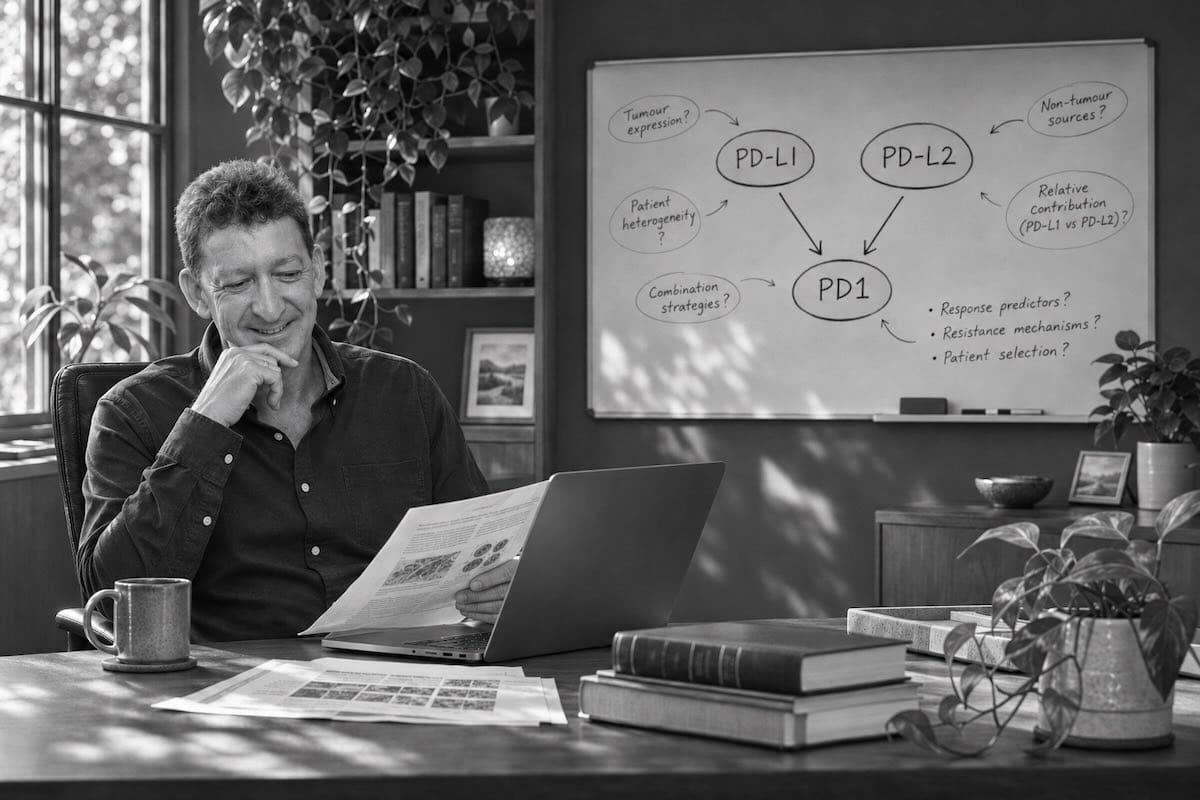
Durvalumab blocks PD-L1, a ligand expressed on the surface of cells, including cancer cells.
But here's a question.
Before Durvalumab failed, did anyone establish whether your tumour actually expressed PD-L1?
That is hardly an insignificant piece of information.
After all, PD-L1 is the very target Durvalumab was designed to block.
Now consider something else.
Keytruda and Nivolumab block PD1, a receptor on immune T cells.
An entirely different biological target.
A different mechanism.
And different clinical trial findings.
But there is something else.
Clinical trials included patients whose tumours did not carry the biomarkers commonly associated with immunotherapy response.
They were not PD-L1 positive, MSI-High or dMMR.
Yet responses were recorded in patients without the expected biomarker profile.
That evidence exists.
So why should failure on Durvalumab automatically close the door to Keytruda or Nivolumab?
Why should a negative biomarker result end the conversation?
And what happens when evidence that challenges those assumptions never reaches the oncologist's consultation room?
The consequences are not simply overlooked research.
They are overlooked opportunities the patient may never get to consider.
I'm Steve Holmes.
In When Evidence Is Left Behind, I follow the biology, examine the clinical evidence and investigate what happens when important findings fail to reach the patient.
Follow the Evidence. Access the Investigations.
Subscribe to CHOLANGIO TODAY to receive access to Steve Holmes' complete patient-led investigations, articles and narrated editions.
Subscribe for Access Free subscription · Opens your email application

Leave A Comment