Steve Holmes
My Stage 4 Cholangiocarcinoma Story

Listen: 14:55 Minutes:
The Deep Dive Podcast, with hosts Rivi and Todd, summarised our story
The First Sign
I am Steve Holmes, a stage 4 cholangiocarcinoma survivor, and this is my story of bile duct cancer, recurrence, Keytruda, complete response, and the Foundation Claire and I built from what survival showed us.
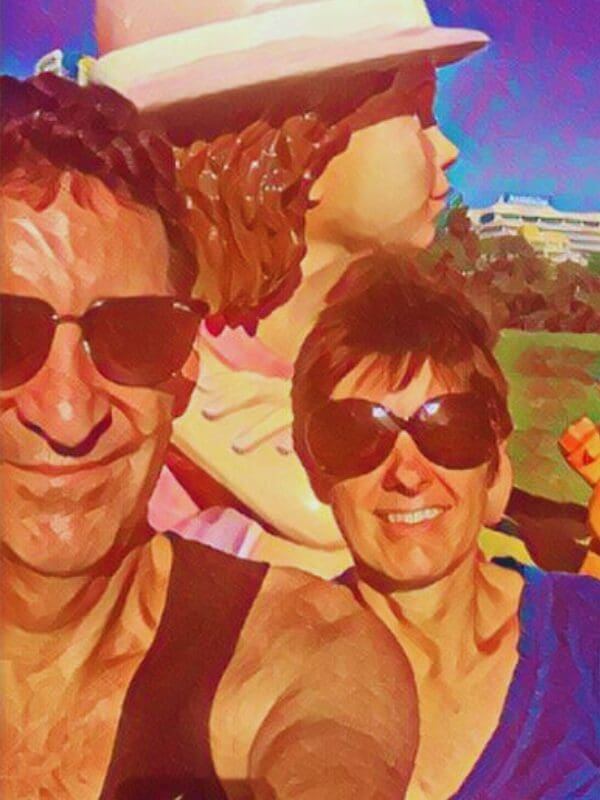
I have been married to Claire since 1989; we have two children. We are both from a small seaside town, Waikanae, in New Zealand’s North Island.
As a family, we moved to Main Beach on the Gold Coast in Queensland, Australia, for schooling and lifestyle.
Healthy lifestyles are a normal way of life in a landscape blessed with beaches, tropical rainforests, and sun-drenched days.
In late October 2016, I was on a regular, easy, flat Saturday morning group coffee ride between Main Beach and Burleigh. Everything was normal as we set out, but about one kilometre into the ride, a sudden wave of weakness came over me. It felt like the onset of a bad flu, and I knew something was not right.
I pulled out of the ride and went straight home.
At the time, I did not know this was the first sign of bile duct cancer. I only knew that my body had changed. I lay on the couch, and the lethargy became more extreme.
The next day, other symptoms became obvious. My eyes began to yellow. My hands became itchy and yellow. My stools became pale and clay-coloured, and my urine became dark.
Claire turned to Google and said, “There must be something wrong with your liver.”
She booked an appointment with our local doctor first thing Monday morning.
The Diagnosis
On Monday morning, our local doctor could visibly see that something was wrong. She suggested it may have been gallstones and told us not to worry, but she ordered urgent blood tests.
The results showed that my liver enzymes were elevated, so further scans were arranged quickly.
At the ultrasound appointment, they saw a shadow and asked me to stay longer for a CT scan. The CT scan showed a blockage in my bile duct. An ERCP followed, where a small brush sample was taken from inside the bile duct.
The brushing confirmed the diagnosis.
I had bile duct cancer, also known as Cholangiocarcinoma.
My GP said I would need to see a surgeon, but still felt it was likely to be gallstones and continued reassuring us. When I mentioned cancer, she said that would be incredibly rare and unlikely. Looking back, she was doing her best to make sure I was not worried.
Choosing a surgeon felt strange. When I asked who she thought would be best, she seemed uncomfortable. In the end, she gave me a list of five local hepatobiliary surgeons and left us to choose one.
The seriousness changed when Claire and I entered the surgeon’s consult room.
There we met Suzanne. She explained that I would be having surgery called a Whipple and began talking through when it would happen. At no point did she mention cancer.
As the discussion continued, she realised Claire and I did not understand what was happening. She stopped and said, “Has no one explained to you that you have cancer?”
I said, nervously, “No.”
Claire and I glanced at each other. Our eyes welled up.
Suzanne’s cold, clinical demeanour changed in that instant. Her tone became warmer and apologetic. She slowed down and explained what was happening.
She told us I had stage 2b extrahepatic distal cholangiocarcinoma. That meant the cancer was in the lower part of the bile duct outside the liver, in the section of duct that passes through the head of the pancreas.
It was the same cancer that had taken my younger brother Graeme just two years earlier.
Suzanne explained that without the operation, I would have less than six months to live.
That was the moment the word patient became real.

From Person to Patient
That night, one thought flashed through my mind.
“Just yesterday, I was a person. Today I am a patient. I must become the best patient I can be, so that I can become that person again.”
I am still not sure why that thought came to me, but I wrote it down. Looking back, writing it down gave it life. That was the moment I shifted from reacting to responding.
Claire shifted with me. She became my caregiver.
Neither of us fully understood what that would require, but we knew life had changed and that we had to face what was in front of us.
The surgery was now the next step. The operation was called a Whipple.
As Suzanne explained it, Claire and I began to realise the size and scale of what was ahead. It filled me with terror.
I had heard the word for the first time in Suzanne’s consult room, and now it was the operation that stood between me and the six months I had been given.
That was the next reality. The Whipple.
The Whipple
On 8 December 2016, I underwent the Whipple.
It was the first major operation.
The surgery removed my bile duct, gallbladder, duodenum, eighty per cent of my stomach, the head of my pancreas, and surrounding lymph nodes. My digestive system then had to be reconstructed so that food, bile, and pancreatic enzymes could move through my body again.
I went into the hospital with cholangiocarcinoma.
I came out physically changed.
The surgery achieved clear margins, which meant there was no visible cancer left at the cut edges of the tissue. That was the result we needed.
But the operation had taken everything my body had to give.
For Claire, the surgery was a different ordeal. I was under anaesthetic. She was awake through it, waiting, receiving updates, and carrying the fear from the outside.
We thought the Whipple was the crisis. It was only the first one.
A month later, I was in bed at home when I began vomiting large amounts of blood and fell unconscious.
Claire was left to manage me as I continued vomiting blood and to call an ambulance.
That became the next emergency.
The Rupture
The Queensland Ambulance Service reached me in about 15 minutes and got me into the emergency wing of the Gold Coast University Hospital in record time.
I had lost a significant amount of blood. My abdomen was full of blood.
It was quickly determined that an aneurysm had burst in my main hepatic artery, a consequence of aggressive surgery, where the tumour had been peeled away from the artery.
A surgical team was hurriedly organised, and as luck would have it, Dr Tom Snow, a talented interventional radiologist, was in the hospital car park about to leave when he received the call.
With only moments to spare, he and his team found the hole, sealed it off, and terminated the artery.
That artery supplied a major part of the blood flow to my liver.
I had survived a major emergency by seconds.
But there are always costs.
By then, across the Whipple and the emergency operations that followed, I had undergone 25 hours of life-threatening surgery.
Recovery and Uncertainty
After the rupture, recovery became harder.
The Whipple had already changed my body. The emergency surgeries and blood loss made everything more difficult.
I was the weakest I had ever been, underweight, and trying to rebuild enough strength to continue treatment.
The surgery had achieved clear margins, and that mattered. It meant the visible cancer had been removed. But cholangiocarcinoma has a way of staying in the room even when the scans appear clear.
I began adjuvant chemotherapy through the ATTICA trial. The aim was to reduce the risk of recurrence and give me the best chance of staying clear.
Claire and I tried to settle into the process. Recover. Attend appointments. Follow the plan. Keep going.
But my body was not recovering well.
I had no appetite, and my weight continued to fall.
I did not tolerate the chemotherapy regimen at all well. For six out of every seven days, I felt like I was pinned to the floor. It was only on the seventh day, the day of the next infusion, that I would remotely begin to feel better and could manage something to eat.
Then I would have to go back for more.
The Tuesdays were long. Twelve-hour hospital days. I remember being halfway to the hospital and pleading with Claire, through tears, to turn the car around. I could not imagine walking back in for more punishment.
The weight was not coming back.
The weakness was getting worse.
Most of my hours were spent lying down, and I struggled to remain seated for any length of time.
I was five months into that chemotherapy routine, with only two more sessions to go, when the scans changed everything again.
The Recurrence
The eight-weekly scan showed that the cancer had returned, and it was no longer only a local problem. It had spread to my liver and both lungs, with too many tumours in my lungs to count. On the scan, my lungs lit up like the night sky.
The liver tumours were large and extending up under my ribcage. This explained the increasing and debilitating pain that had continued to build with every breath I took. Each breath felt deliberate. I was tiring, and the pain was increasing.
That was the moment everything changed again. The first diagnosis had made me a patient, but the recurrence made me a late-stage patient. I had gone through the Whipple, survived the rupture, endured months of chemotherapy, and still the cancer had found its way back.
From the beginning, Claire and I had been constantly told to be realistic. This cancer had no real options outside surgery, and surgery had now failed to hold it back. Here we were, facing yet another seemingly insurmountable obstacle.
It is difficult to explain what happens when that reality crashes through your front door. There is no future. There is just nothingness. I had never realised how important having a vision was to my existence. Like everyone, I had taken that for granted.
For me, Graeme was there in that moment too. Not physically, but in the only way he could be. He had died from the same cancer, and now I was standing where he had stood.
The difference was that one more piece of information was still to come.
The Test That Changed Everything
That piece of information came from genomic profiling.
At the time, genomic profiling was still very new in cholangiocarcinoma, and clinical trials for bile duct cancer were rare. My oncologist, Dr Matthew Burge, was fortunately leading a new international clinical trial and was looking for potential patient candidates.
He had arranged to review the histology of my tumour to see whether it carried the markers that might match the trial he was leading. That testing found something important. My cancer was MSI-high and dMMR.
I remember sitting in the chemotherapy chair, about to begin another gruelling session of infusions, when Matt came out to see me. He told me he had something for me. He was excited, but I did not yet understand what those words meant or why they mattered.
At that time, as I understood it, this trial had not yet produced a successful cholangiocarcinoma outcome. But Matt believed I could be that person.
MSI-high and dMMR meant my cancer carried a weakness that immunotherapy may be able to recognise and act on. That result created an opportunity through a clinical trial called KEYNOTE-158, using pembrolizumab, also known as Keytruda.
When I was first diagnosed, that option was not there. Six months earlier, that trial opportunity did not exist for me. Now, at the edge of everything, it had appeared.
It was not certainty, and it was not a cure being handed to me. It felt like a late Hail Mary pass being thrown in my direction. All I had to do was catch it. Where there had been nothing, there was now an opportunity, and at that point, an opportunity was everything.
KEYNOTE-158 and Keytruda
The opportunity was the KEYNOTE-158 clinical trial.
The treatment was pembrolizumab, more commonly known as Keytruda.
To enter the trial, I still had to be well enough to qualify and well enough to begin. That became the next challenge. I was weak, in pain, losing weight, and physically declining. The trial was there, but I still had to reach it.
When it came time to sign the trial consent forms, I was so weak I could barely sit upright in the chair. To sign the documents, Claire had to lift my arm while Matt placed the pen in my hand.
Matt, a fellow road cycling tragic, had great faith in my inner stamina.
The room was full of medical people, all looking on. When I signed, I could feel their relief.
Matt placed his hand on my cheeks so we could look at each other face to face and said, “Steve, you have one job: stay well enough to start the trial.”
I took that to mean, “Steve, you have one job. Keep breathing. That is your job.”
At its roots, that was the culture of cycling embedded in our relationship.
That moment stayed with me because the opportunity was real, but so was the condition I was in.
On 21 August 2017, I received my first infusion of pembrolizumab.
I did not know what would happen.
I only knew the Hail Mary pass had been thrown, and now I had to catch it.
The Response
My first Keytruda infusion was different from chemotherapy straight away. After months of gruelling 12-hour Tuesdays, I was only in the chair for about two hours.
I barely remembered that day, but three days later something happened that I found difficult to explain.
The severe rib and shoulder pain suddenly disappeared.
I was lying on the couch on my left side when it happened. Claire was on a bean bag on the floor, staying close as always to be ready if I needed help. I quietly turned and then sat up unassisted, which was not normal. Testing if this was real.
There was no pain.
I could breathe normally.
I said to Claire, “Something is wrong.”
She said, “What?”
I said, “All the pain has gone.”
She said, “What is wrong with that?”
Then she paused.
This was the first time something good had happened. I said, “If the pain was because the tumours were growing, does this mean…” Neither of us wanted to finish that sentence.
Claire said, “Maybe it’s the Keytruda,” and I remember thinking, what Keytruda? She said, “It was only three days ago. Maybe it’s working.” I had completely forgotten I had even had it.
With that, I stood up, which was also rare, and asked Claire if she could take me outside for a walk in the sunshine. She did. Those few steps are hard to fully describe. There was a sense of the greatest freedom and empowerment flowing through me.
The pain had not slowly improved. It had suddenly disappeared. The question was impossible to ignore. If growing tumours had been creating more pain, could the disappearance of the pain mean the tumours were shrinking?
Could that happen after just one infusion in just three days?
I did not know where to put my mind. We did not want to get our hopes up too high, because everything would come down to the first Keytruda trial CT scan. Cautious optimism still felt too hopeful, but it is the best way I can describe how I felt.
Then, on day four, the next day, 12 August, I was plunged into a new battle.
An itchy chest cough started, followed by severe sweating, extreme temperature spikes from freezing cold to boiling hot, severe weakness, light-headedness, and difficult breathing. I could barely function and could not get up.
The jubilation of the day before vanished as quickly as it had arrived. I was now in another battle for my life, with the feeling that this might be the end.
It happened so fast. I later came to understand that this was a cytokine storm at its highest response level. My immune system had been switched on with such force that it nearly overwhelmed me. The irony is that what can work can also kill you.
Now at my absolute lowest point, our son Zach arrived home from London as a surprise. I had no words through my tears when he appeared in front of me. I could not even stand to give him a cuddle.
Zach was visibly shocked by my weakness and physical decline, but in that moment it did not matter. His timing was more than good. His presence had caught me from falling and from giving up.
Just before he arrived, I had reached the point where I felt this cancer was going to take me and I would not be able to keep going
Life does not move in straight lines.
That was the moment I felt closest to letting go.
Zach stayed for seven days and took over some of the nursing duties from Claire. He lay on the bed next to me, held my hand, told me about his adventures, and spun a few jokes to get a rise out of me. Most of the time I lay there fairly motionless in a semi-conscious state, but now and again I would sit or stand, just to keep everyone on their toes.
Claire booked an unscheduled appointment with Matt because she was growing very concerned by my decline and my reaction after the first treatment.
On a phone call, Matt said it may have been a war going on between my immune system and the tumours, or it may not have been the treatment at all. It may have been a virus that was going around. He said we would know more after the second infusion, because we would see whether the same pattern continued.
But the storm continued for more than two weeks. I lost a lot of weight and physical condition. Then, on day 20, just one day before my appointment with Matt and the planned second infusion, the clouds parted, the sun came out, and the storm was gone.
I felt amazing, although that should be tempered by the fact that I looked anything but amazing. I looked very bad.
When I met Matt for the second infusion, I do not think he would have realised the severity of the battle I had just survived. After that infusion, nothing happened. There was no repeat of the same crash. In fact, I continued to strengthen with every new day. I was finally off the couch and beginning to function more normally.
I was even eyeing up the bike. Could I do it?
Claire was not too happy about that idea so soon. To be fair, I had put her through the emotional and physical wringer as well. Claire needed a break, so I put the talk of bikes on hold.
The First Scan
The first Keytruda trial CT scan was set for Thursday, 5 October 2017.
In my diary, I described it as one of those betwixt and between moments in life.
I had been looking forward to getting the scan completed, but the closer I got to the day, the more scared I became. I wanted it done, but I was scared to think about what the results might show.
The previous scans had shown new tumours on the top of my liver, which explained the severe rib and shoulder pain. It had been hard to breathe. Lying on my side was impossible. Even doing up my shoelaces was difficult.
Matt had explained that the tumours were causing the pain.
But the pain had fully disappeared three days after my first Keytruda infusion, and that left me with one thought I could not put away.
If the tumours were growing and creating the pain, and the pain had gone, could I dare to believe the tumours were shrinking?
Could it happen that fast?
Now this was the day to find out.
Of course, the results would not be available until Tuesday, 10 October, when I sat down with Matt before my next infusion. Such is life. Back to the proactive waiting game.
I had to keep my mind busy on other, more exciting things in life.
Just relax.
Ha ha.
Conservatively optimistic sounded right on one hand, but I was still edgy and nervous on the other. I did not want to get ahead of myself, especially because I was now feeling the best I had felt in 12 months and had regained some fitness, which I was absolutely loving.
That was the tension of scan day.
Hope was back in the room, but it still had to prove itself.
Complete Response
Tuesday, 10 October 2017.
My first Keytruda scan results were in after three months and three infusions.
Claire and I met with Matt at 10:30 am after what I can only describe as an agonising betwixt and between lead-up to that moment. I was desperate for good news, but absolutely petrified that I would get yet again more bad news.
I had reasons to believe it could be good. I felt great. Since the second infusion, I had improved out of sight. I had recently started cycling again and had even shuffled out a four-kilometre run. None of that had been possible only a few weeks earlier.
Matt began by showing Claire and me the August 2 scan, which Claire had not seen. The tumours were more numerous and bigger than I remembered, and there were even more across the top of my liver and just under the ribs. It did not feel like the start of a good day.
Then Matt, with his best poker face on, brought up my latest scan from October 5. I looked at the scan image on Matt’s screen, then looked again.
“Where are the tumours, Matt?”
Matt said, “That’s just it, Steve. There aren’t any. You have had a complete response.”
I asked, “What does that mean?”
Matt replied, “You don’t have any tumours or evidence of cancer, Steve.”
My reply sounded like a stuck record. “Yes, but what does that mean?”
Matt said, “Steve, go out and celebrate. They have gone, and I don’t think we will see them back.”
Claire and I were completely shocked. In some ways, it was a bigger shock than being told I was terminal. My best hope going into that appointment was that the tumour growth had stopped and maybe there were signs of shrinkage. Instead, the tumours were gone.
It felt like I had hit the ball out of the park with my first swing.
Matt, who had been confident, was also stunned at seeing this. Of course, he had already had a couple of hours to prepare his best poker face. Claire and I had no preparation at all. We just looked at each other, welled up with tears, with no words. I think we all just looked at each other, we had no words. Matts grin said it all.
I tried to thank Matt, but I could not find words that felt big enough.
Matthew Burge had saved my life.
Matt explained that we still needed the next scans to build confidence in the durability of the response. I understood that. Cholangiocarcinoma is tricky and cruel, and I knew I could never fully drop my guard, I needed to stay in battle mode.
The CT scan report said complete response. The August 2 scan had shown seven large tumours across the top of my liver and under my rib cage. The October 5 scan showed no tumours. My weight was back up to 70 kilograms.
I was shocked, stunned, and numb. Then slowly, a new realisation began to creep in. A new day had dawned. The sun felt warm, the sky looked brilliant blue, and the ocean looked crystal clear, as if I was seeing it all for the first time.
I had a brand-new outlook. I wanted to live sensibly, keep rebuilding, and hope that Cholangio the Beast had left the building. I also hoped that somehow, my story might one day help others facing this terrible diagnosis.
The Response Held
The complete response on 10 October 2017 changed everything, but it did not remove uncertainty.
Matt had been clear. We needed the next scans to build confidence that the response would hold. I understood that. Cholangiocarcinoma had already shown me how quickly life could change, and I knew better than to think I could simply walk away from it.
So the next part of my life became a different kind of waiting.
The rhythm of life became three-month scans, blood tests, appointments, rebuilding fitness, and trying to live normally while still knowing the next scan could change everything again.
I kept cycling. At first, it was small and careful. Then gradually I became stronger. The bike had always been part of who I was, but now it also became part of how I measured my return to life.
Claire was still carrying the weight of it too. A complete response did not erase what she had lived through. She had watched me weaken, bleed, collapse, enter surgery, face stage 4 disease, and then somehow begin to recover. Survival was a gift, but it still had to be absorbed.
Over the following months, the scans continued to show no evidence of disease.
The response was holding.
Keytruda had not just created a moment.
It was giving me time.
Eventually, after 15 months of Keytruda infusions, I voluntarily stepped away from treatment.
That was when Matt said something I have never forgotten:
“Steve, there are many that we help a little and some we help a lot, and then there is you. Go out there and ride your bike and do something special with the opportunity you have been given. See you in three months.”
That sentence stayed with me; it felt like being handed back a life. But it also left me with a question.
What was I going to do with the enormous opportunity that life had handed back to me?

What Survival Opened
Surviving did not feel like an ending.
It felt like being handed something I did not yet fully understand.
For a long time, I had been focused on staying alive. Get through surgery. Get through the rupture. Get through chemotherapy. Stay well enough for the trial. Make it to the next scan. Then the next one.
When the response held, another question slowly appeared.
What now?
I kept coming back to how close everything had been. How close I had come to not making the trial, and how close the genomic result had come to being just another piece of information that arrived too late, or more likely, was never looked at closely enough for the opportunity to be seen.
That had become a theme throughout my journey. A number two surgeon, who understood my passion for cycling, suggested a new adjuvant clinical trial. I said yes, even though I was told the chemotherapy would most likely not work. Without that decision, I may never have met Matt, also a fellow cycling tragic, or reached the groundbreaking clinical trial he was leading. If Matt had not looked deeper into my tumour biology, the opportunity may never have appeared. If I had declined too quickly, or if the timing had shifted even slightly, I could have fallen into any one of those gaps.
There were so many gaps I could have fallen into.
How close Claire and I had come to never understanding what had actually changed my pathway.
That stayed with me.
I had survived because the right information was found in time, and because the right people knew what to do with it.
But I could see how easily that might not happen for another patient.
Not because people did not care.
Because cholangiocarcinoma moves fast, the system is complex, and patients are often trying to understand their diagnosis while decisions are already being made around them.
That was the part I could not let go of.
My story had not ended with a complete response.
It had opened another story.
The Gap Between Diagnosis and Understanding
That experience revealed the gap between diagnosis and understanding, the space where options are quickly lost.
I had lived inside that gap.
I was told I needed a surgeon before I knew I had cancer. After surgery, I was told there were no real follow-up options. No chemotherapy. No radiation. They would not work. I was not told much about bile duct cancer, other than that it would probably come back.
I was not referred to anyone who specialised in this cancer. The message felt simple: go home and make the best of it.
That was when the number two surgeon, Dr Kwong, who had taken a liking to my passion for cycling, decided to look a little deeper. He had done some research and found a possible option through a German Gem/Cis clinical trial called ATTICA, which is being run in Australia at the Royal Brisbane and Women’s Hospital.
It was not presented as a cure. In fact, I was told the chemotherapy would most likely not work. But it was an option where there had been no option, and Claire and I jumped at it.
That extra bit of work changed everything. It set a new path in motion.
If Claire and I had not said yes to that rare clinical trial, I may never have met Dr Matthew Burge. If I had never met Matt, he may never have looked deeper into my tumour biology. If he had not looked deeper, the MSI-high and dMMR result would never have been found. If that result had not been found, the KEYNOTE-158 trial may never have opened to me.
There were so many gaps I could have fallen into.
Around that time, I met another patient in the waiting room at Royal Brisbane.
His name was Adam. He was a young father from Mackay, married to Sarah, with three small children.
Adam had bowel cancer. He had been told there was no realistic chance he would survive more than six months. His oncologist had given up on further options.
Then that oncologist went on holiday, and a stand-in oncologist saw Adam. The stand-in looked at him and asked, “Have you had genomic profiling done?”
Adam said, “What’s that?”
That question changed his pathway.
The stand-in oncologist looked at Adam’s histopathology report and identified that he may match a trial in Brisbane. That was how Adam ended up at Royal Brisbane, and that was where Claire and I met Adam and Sarah in the waiting room.
At the time, I wrote in my diary that Adam was similar to me, but had been on the trial for just over a year. He had also been terminal, with tumours in several organs, and by August 2017 he was cancer-free.
Meeting Adam and Sarah was powerful. Adam was very different to me as a person and had approached the whole cancer nightmare differently, but listening to him taught me a lot. It was as if we were in the same club. At times, we did not need words to understand each other.
It was bloody weird, but it was uplifting.
Adam’s story stayed with me because it showed the same thing I was beginning to understand in my own story. One person looked again. One question was asked. One report was read differently. One pathway appeared where there had been none.
That is the gap.
I began to understand that survival opportunity can depend on the smallest decisions, the extra question, the extra search, the extra clinician who looks again, and the patient or caregiver who says yes before they fully understand where the road might lead.
That stayed with me.
I began thinking about newly diagnosed patients and families arriving at the same point Claire and I had reached. Shocked. Tired. Searching. Trying to make sense of pathology reports, scans, surgery opinions, treatment choices, genomic testing, clinical trials, and survival statistics while the disease was already moving.
That is a lot to ask of a patient who was, only yesterday, just a person.
It is also a lot to leave entirely to busy medical professionals, many of whom are working under pressure and cannot always slow the system down enough for a newly diagnosed cholangiocarcinoma patient to catch up.
This is where the Foundation began to take shape.
Building the Foundation
The Foundation did not begin as an organisation in my mind. It began as a question.
If Claire and I had seen so many gaps in my own pathway, how many other gaps existed that we had not yet seen?
How many other people were falling into them? How many were dying because information had not connected them to opportunities that may have changed their pathway? That was a harsh reality that washed through us. People could be dying without ever knowing there may have been options that could lead to new survival opportunities.
That thought inevitably took me back to Graeme.
Could my brother have had opportunities we never knew about? Could there have been another pathway, another question, or another person who might have looked again? Could he have been like me?
I will never know.
What I do know is that his hospital did not really know this cancer. He was cared for by young, inexperienced oncologists on rotation, without the deeper cholangiocarcinoma knowledge this disease demands.
That does not mean people did not care. It means the system around him was not built for a rare, aggressive cancer moving faster than the people trying to understand it.
His family was crushed by an early death.
Mine could have been too.
That is the truth I could not move past.
At first, the gaps I could see were practical. Diagnosis. Surgeon choice. Follow-up options. Clinical trials. Genomic profiling. Timing. The right person looking again. But underneath those practical gaps sat a larger question that would not leave me alone.
What was this cancer, and why had it happened to both Graeme and me?
Graeme had two children. I had two children. This was no longer an abstract medical question. It was sitting inside our family.
When I asked why this had happened, the answer was usually that it was most likely genetic, or simply that no one really knew. That did not sit right with me.
I do not say that as criticism. Medical professionals were busy diagnosing, operating, treating, reviewing scans, prescribing, and trying to keep people alive. Their job was to respond to the cancer in front of them. But no one seemed to have time to pause on what made this cancer possible in the first place.
I could not stop looking upstream.
I had survived because someone looked deeper into my tumour biology. That made me wonder what else might be found if someone looked deeper into the biology before the tumour. What was happening in the bile ducts? What was happening in bile flow? What was happening in the lining? What injury had been there before cancer formed? What had to fail before cholangiocarcinoma became possible?
Those questions became part of the work.
Claire and I began building Cholangiocarcinoma Foundation Australia from the patient side and the caregiver side. We were not trying to create another layer of noise, and we were certainly not trying to build another advocacy or awareness charity.
That is the thing about being a patient and surviving what was termed unsurvivable. You do not look first to awareness. You look to what works for survival now, not years from now.
In the years since Claire and I began doing this work, one thing has become increasingly clear. Medicine is moving, but not fast enough for many patients sitting in front of this disease today. Cholangiocarcinoma can outpace the system before a patient even understands what the system is offering.
New treatments matter. Research matters. But for many patients, the greatest immediate survival opportunity may still come from better organisation of what already exists. Earlier understanding. Earlier expert review. Earlier surgical opinion. Earlier genomic profiling. Earlier connection to clinical trials. Earlier recognition of what should not be missed.
Surgery remains one of the strongest immediate opportunities for survival, but too few patients ever reach that point. If more patients are reviewed earlier by surgeons who understand cholangiocarcinoma deeply and operate on it regularly, more may be found to have options that were not obvious at first.
That is why structured information delivery matters. A disciplined process, such as the Patient Navigator Journal, can help patients and caregivers organise the right reports, ask the right questions, and move earlier while options still exist.
And then there is the bigger question.
If better process can improve survival now, what could happen if we better understood the cause?
What if we understood bile better?
What if we centralised bile health knowledge, mapped the evidence, and asked what was happening before cholangiocarcinoma formed?
That is where the work began to widen.
There were already organisations doing awareness, advocacy, and research funding. Many of those things matter. But my experience had exposed another gap: an organisation prepared to draw a line in the sand and build around today’s survival, for today’s patients. Patients like me. Patients like my brother.
We were trying to build what we had needed earlier: clearer understanding, better organisation, earlier questions, and a way for patients and families to see the pathway before options disappeared.
At first, it was about helping patients understand what I wished we had understood earlier. Then it became bigger. It became about mapping the gaps, asking better questions, helping patients respond earlier, and pushing toward the cause.
The idea of supporting patients and their families had evolved into something more precise. It had to meet the needs of today’s patient today. Not the needs of a charity. Not the needs of the industry around them. The needs of survival now.
That would become this Foundation.
Because if we do not understand what makes cholangiocarcinoma possible, we are always arriving late.
What I Want Patients and Families to Know
If you or someone you love has been diagnosed with cholangiocarcinoma or bile duct cancer, I know how quickly the ground can move beneath you.
One day you are a regular person living your life. The next day you are a patient trying to understand scans, blood tests, pathology reports, surgery options, treatment plans, survival statistics, and words you have never heard before.
You do not need to understand everything at once, but you do need to get organised early.
Find out exactly what type of cholangiocarcinoma you have. Ask whether it is intrahepatic, perihilar, or distal extrahepatic. Ask whether surgery has been reviewed by a team that sees this cancer regularly. Ask whether molecular profiling or genomic profiling has been ordered. Ask whether there are clinical trials that match your disease. Ask what reports you need to collect, and keep them together.
Do not assume that no option exists because one has not yet been offered.
That does not mean every patient will have the same pathway I had. They will not. My story is rare, and I know that. But rare does not mean irrelevant. It means the details mattered.
In my case, the right report mattered, the right surgeon mattered, the right oncologist mattered, the right trial mattered, the right timing mattered, Claire mattered, and the process mattered. Any one of those pieces could have easily been missed.
That is what I want patients and families to understand. Survival opportunity can sit inside details that are easy to miss when everything is moving fast.
So start with the next step. Get organised, ask the questions, keep your reports together, and seek experienced review early. Do not wait until everything makes sense before you begin, because I could have fallen through any one of those gaps, and many patients do.
That is why this Foundation exists.

Where My Story Now Sits
My story did not end with a complete response. That was the point where another unexpected responsibility began.
I had been given back time that my brother did not receive. I had been given a pathway that could easily have been missed. I had seen how much survival can depend on timing, information, persistence, and the right people looking in the right direction. Claire and I could not unknow that.
The Foundation became our response to what we had lived, what Graeme had not survived, and what too many patients still face when they are diagnosed with cholangiocarcinoma or bile duct cancer.
I do not tell my story because it is typical. It is not. I tell it because it shows what can sit inside the details, and what can be lost when those details are missed.
That is why we build around the more difficult truth of today’s patient survival, now, today. That is why we focus on earlier understanding, organised response, and the cause, because patients should not have to wait for survival knowledge to find them. It should meet them at the start.
When my response had held and I stepped away from Keytruda, Matt said something I have never forgotten:
“Steve, there are many that we help a little and some we help a lot, and then there is you. Go out there and ride your bike and do something special with the opportunity you have been given. See you in three months.”
That became the question Claire and I had to answer. What do you do with an opportunity like that?
For us, the answer became the Foundation. Not just for the patient, but for the family around them, the community that carries them, and the people still trying to find their next step.
Because hope is not just a feeling. Hope is seeing the next step. Claire and I built this Foundation to help patients see it earlier, follow the process, and keep options open while they still exist.
That is where process becomes a gamechanger. When it is built from lived experience, it gives the patient and their family something to hold onto, something to follow, and something to act on before options are lost.
We knew enough to begin. Not because we had all the answers, but because it had to be done.
We had no support, but that did not deter us. Patients did not have time to wait for perfect conditions, and neither did we.
The Patient Navigator Journal
Cholangio.org builds the pathway.
The Patient Navigator Journal helps patients travel it.
This free guide helps patients and caregivers organise tests, track results, prepare questions and navigate cholangiocarcinoma step by step.
Download your free journal here: