Why We Built a Survival System for Cholangiocarcinoma
Recently we published How We Win, the public version of our cholangiocarcinoma survival system, the Cholangio Strategy OS.
It explains the survival system guiding the work of the Cholangiocarcinoma Foundation Australia.
This article explains why that system had to be built.
And how it works.
In our recent article, Mistakes That Quietly Cost Cholangiocarcinoma Patients Their Best Chance, which followed a series of patient success stories, those stories revealed gaps patients often encounter after diagnosis.
Those gaps are not caused by a lack of effort from doctors, families, or researchers.
They exist because of how cancer systems are structured.
Understanding those gaps is the first step.
Building a system that helps patients navigate them is the next.
The Gap in Cancer Systems
Most healthcare systems are designed around two phases of disease.
Diagnosis.
Treatment.
Hospitals, oncology teams, and clinical trials operate primarily within that space.
When cancer is detected, the system moves quickly to determine the type of tumour, stage the disease, and begin treatment.
That part of the system works remarkably well.
But cholangiocarcinoma does not begin at diagnosis.
It begins much earlier.
At the level of cells, tissue injury, and biological stress.
And the journey does not end with treatment either.
Patients must still navigate recurrence risk, monitoring, long term health, and ongoing decisions.
In reality, the full arc of cancer looks like this:
Cause
Diagnosis
Treatment
Recurrence prevention
Yet most systems operate mainly in the middle.
Diagnosis and treatment.
Everything on either side is far less known and structured.
Patients and families often discover this quickly.
They must gather information, interpret medical advice, seek second opinions, coordinate care, and manage decisions under pressure.
The terrain is complex.
And the pathway through it is rarely clear.
The Human Cost of Fragmentation
When the phases of a disease remain disconnected, patients carry the burden of navigating between them.
Signals can be missed.
Opportunities for earlier response may pass unnoticed.
Important decisions may be delayed while people try to make sense of complex information.
This is not a failure of individuals.
It is a structural feature of the system.
Cancer care evolved to treat disease once it becomes visible.
But survival depends on much more than treatment alone.
It depends on how effectively patients, clinicians, and communities move through the terrain between cause, diagnosis, treatment, and recurrence prevention.
Over time, this became clear to us.
Improving survival required more than new treatments.
It required a way to organise the journey itself.
Why We Built a Survival System
The work of the Cholangiocarcinoma Foundation Australia focuses on building what we describe as a patient-led survival system.
A structure that helps people move through the full arc of the disease more deliberately.
The system is built around a simple sequence.
Truth
Pathway
Navigation
Learning
Alignment
Survival Culture
Each stage strengthens the next.
Together they form a system that improves over time.
Truth
Every survival system begins with reality.
Understanding the biological terrain of cholangiocarcinoma allows patients and clinicians to see the sequence clearly.
Where the disease begins.
How it develops.
Where intervention becomes possible.
Clarity removes confusion.
It helps people make decisions grounded in what is actually happening.
Pathway
Once the terrain becomes visible, the next step is mapping the pathway through it.
Knowledge alone is not enough.
Patients need to know what to do next.
The pathway translates medical understanding and patient experience into a sequence people can follow.
It turns complex terrain into something navigable.
Navigation
Even the clearest pathway requires tools.
Navigation helps patients organise information, track decisions, and coordinate their response with their clinical team.
Without navigation, the pathway remains theoretical.
Navigation turns knowledge into movement.
Learning
Every patient journey contains lessons.
When those lessons are captured and shared, the pathway improves.
Patterns become visible.
Mistakes can be avoided.
Opportunities appear earlier.
Over time, the system becomes smarter because every journey contributes to the next.
Alignment
Survival also depends on coordination across the wider ecosystem.
Patients, clinicians, researchers, and supporters often work toward the same goal from different parts of the system.
Alignment helps connect those efforts.
When the ecosystem works together the gaps between cause, diagnosis, treatment, and recurrence prevention begin to close.
Survival Culture
Over time these elements create something larger than individual programs.
They create culture.
Patients become better informed.
Clinicians engage earlier.
Communities begin to recognise the importance of coordinated response.
That culture becomes a survival system in its own right.
As it strengthens, it drives earlier detection, faster response, and stronger pathways for future patients.
The system learns.
Then the cycle begins again.
The Human Disciplines of Survival
Systems alone do not create survival.
People do.
Across many patient journeys, we see three disciplines repeatedly shape how individuals move through the cancer terrain.
Right perception.
Right action.
Will.
Right perception means seeing the situation clearly.
Not through fear or assumption, but through the facts that define the terrain.
Once perception stabilises, right action becomes possible.
But survival often depends on taking the right next step, not simply the next step.
Finally, there is will.
There are moments in every difficult journey when uncertainty grows and energy fades.
Will is what allows people to continue moving forward when the path narrows.
These disciplines form the human interface with the survival system.
The structure helps organise the journey.
People bring the perception, action, and will required to travel it.
How We Win
The principle guiding this work is simple.
The cure is in the cause.
When the cause of disease becomes visible, prevention and earlier response become possible.
But reaching that point requires more than knowledge.
It requires a system that helps patients, clinicians, and communities move deliberately across the full arc of the disease.
That system is explained on the page How We Win.
That page presents the public expression of the survival system guiding the work of the Foundation.
The deeper architecture sits within the Cholangio Strategy OS.
Together, they describe the system we are building to improve survival in cholangiocarcinoma.
Steve Holmes
Founder
Cholangiocarcinoma Foundation Australia
www.cholangio.org
Architecture
This article sits within the survival system developed through Cholangio.org.
Doctrines Of Cholangio
↓
Cholangio.Org OS:
Systemising Cholangiocarcinoma
Operationalising the response.
↓
How We Win
Activating The Foundation
Activating The Patient
↓
The Survival System
Behind the Foundation
↓
The Three Survival Disciplines
The human interface to the system
↓
Explore the system:
How We Win →
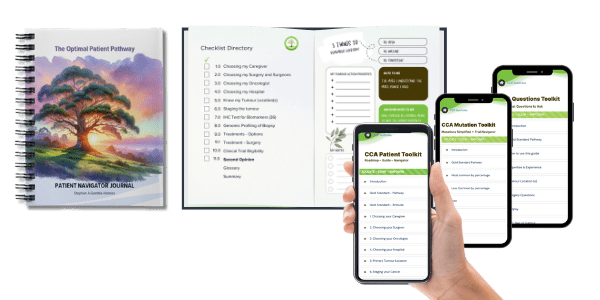
The Patient Navigator Journal
Cholangio.org builds the pathway.
The Patient Navigator Journal helps patients travel it.
This free guide helps patients and caregivers organise tests, track results, prepare questions and navigate cholangiocarcinoma step by step.
Download your free journal here: