Stephanie Kleine-Ahlbrandt
Staying Alive. Staying Yourself

Patient Review
by Steve Holmes
I recently read Stephanie Kleine-Ahlbrandt’s latest blog. What she has built is more than a story. It is a cholangiocarcinoma survival pathway.
“Still here: Five Years with Stage IV Cholangiocarcinoma
How I Stayed Alive and Stayed Myself”
Five years.
That’s a long time in our cholangio world. A line in the sand many aim for.
Surviving stage IV cancer of any type is a remarkable feat.
Surviving five years with cholangiocarcinoma sits in a category of its own.
It draws attention.
And with that, something else emerges.
Responsibility.
Responsibility is not an obvious quality that comes to mind when facing a cancer such as cholangiocarcinoma. Yet self-responsibility is. And as you move through its obstacles, it begins to change. It becomes a responsibility to share what worked and what did not. To benefit those who follow. To serve a community you did not know you were part of. To strengthen and sharpen a culture that becomes a survival system in itself.
The right perception is everything in a cholangio challenge
As with Stephanie, what towered before me was what seemed an unbeatable cancer beast. I came to call it “Cholangio the Beast”.
I think I had read too many David and Goliath stories as a child.
But to give of yourself in such circumstances is a different kind of power. One Goliath cannot see.
Goliath is only unbeatable until he isn’t, until cholangiocarcinoma isn’t.
Sharing may seem easy. It may seem it only belongs to those who win.
That is not true.
Sharing under pressure begins earlier than that. It begins when you stop looking away and start facing what is in front of you.
It is not clean. It is not controlled. There is no well-choreographed script. You just begin sharing.
You begin to speak, to write, to make sense of what is happening while you are still inside it. What comes out may not be what you expect, but it must come out. That is how you see your own situation truthfully and clearly.
It is a process, a recalibration process. It is an important shift.
That is where the challenge truly begins. Not before.
That is when you begin to share what you’ve learned in a way others can use. That is where you learn about what you have endured, what to carry and what to ditch.
That is what Stephanie is doing here.
If you read back through her earlier posts, you will see it building.
Layer by layer.
Step by step.
Leading to this.
For that, I congratulate her.
Not just for surviving.
But for stepping forward and sharing herself publicly.
Stephanie has, as I did, found structure and momentum within her words. Not because they are public, but because she sees herself more clearly when they are in front of her.
Because in the early days of diagnosis, most people search for the magic pill. They focus on the big picture.
I have this big, unbeatable cancer. They seek the power of the magic pill.
They may see patient stories like Stephanie’s, but they miss the steps within them. Those are the magic steps.
Stephanie has come through this because she was not distracted by the overwhelm of the big, scary picture. She focused up close. She saw the small, winnable steps.
She saw clearly.
She acted on what was in front of her, on what she could control.
She was not slowed by what was not in her control.
She kept moving. She kept momentum, and momentum is the magic of life.
So when you read her story, don’t skip to the end. Look for the layers. Look for the steps.
Stephanie offers something rare.
Not reassurance.
Not noise.
A light.
Her story is a journey. A pathway she has forged between the unlikely and the impossible.
There is a strategy in how she has moved.
She did not allow herself to be held back by convention or constrained by the system. She looked beyond those constraints. They belong to the system, not to her will to survive.
She leaned in.
And kept leaning.
Not in spite of this cancer, or a system constrained.
But because of it.
That is her shift. And that shift changed her outcomes.
When there is no other way, we must push all the way through. Every negative has its opposite.
But you only find it if you push all the way through.
Cancer patients suffer a lot.
That’s what it is to be a patient.
So anything we, as survivors, can do to reduce that suffering, to make life more liveable, is a good thing. A meaningful thing.
Sharing our battle-earned knowledge and experiences does exactly that.
It shines a light on what’s possible.
It sends a message to a community, a culture, thirsty to learn what works.
Stephanie sharing her blog posts, what she has learned, her way, does exactly that.
Do not underestimate the power of responsibility to self and to community. Responsibility strengthens when you face this cancer’s truth.
And part of that truth is patients like Stephanie.
There are others. Many others.
That is also part of your truth.
From there, something shifts.
You stop waiting.
You start moving.
And when that happens, something else emerges.
Your own will.
Quiet.
Steady.
Unbreakable.
Stronger than you ever thought possible.
Staying Alive
What stood out to me was not just that Stephanie is still here.
It is how she has moved through this.
If you read her story carefully, you begin to see a pattern.
Not emotion.
Not chance.
A sequence.

Staying Yourself
Stephanie begins with what is real.
“The diagnosis was stage IV intrahepatic cholangiocarcinoma… a tumor 13 by 11 centimeters… wrapped around the portal and hepatic veins, and already spread to distant lymph nodes. I was told immediately: inoperable. Incurable.”
No padding. No softening.
Just the terrain as it is.
But she does not stop there.
She places that reality inside its true context.
“Surgery is the only treatment that offers any chance of cure… For the rest of us, treatment is not curative but palliative, meant to slow the disease and, if you insist on it, preserve a life you still recognize as your own.”
She understands what is possible.
And what is not.
And inside that, she makes a decision.
To preserve a life she still recognises as her own.
From there, her thinking becomes clear.
“Treat the sites of progression locally, and keep going.”
That is the mechanism.
Control what is moving.
Preserve what is working.
That is how time is extended.
And over time, that way of thinking settles into something deeper.
“The goal for me is not the longest possible life.
It is the most alive possible life, for as long as it lasts.”
That line stayed with me.
It was so relatable, something I could understand, hold and carry forward.
Because it holds through those times when decisions become difficult.
When trade-offs are real.
When there are no guarantees.
This is what I noticed.
There were no promises in her path.
In many ways, quite the opposite.
But she did not wait for certainty.
She saw clearly.
She acted on what was in front of her.
And she kept moving.
Journeys Within and Beyond
If you read her full piece, take your time with it.
Do not read it for the ending.
Read it for the steps.
Look for the decisions.
Look for the adjustments.
Look for how she keeps moving where others often stop.
There is more there than a story.
There is a way of seeing.
A way of responding.
Her writing sits within Journeys Within and Beyond —
from war zones to hospital rooms, letters on impermanence, compassion, and finding hope amid despair.
By Stephanie Kleine-Ahlbrandt.
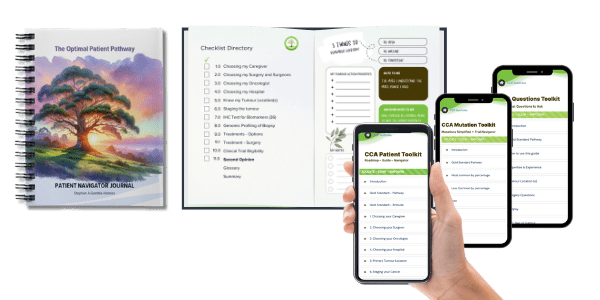
The Patient Navigator Journal
Cholangio.org builds the pathway.
The Patient Navigator Journal helps patients travel it.
This free guide helps patients and caregivers organise tests, track results, prepare questions and navigate cholangiocarcinoma step by step.
Download your free journal here: