Mistakes That Quietly Cost
Cholangiocarcinoma Patients Their Best Chance

Author
Steve Holmes
The Cholangiocarcinoma Diagnosis Mistakes Most Patients Never See
If you have been diagnosed with cholangiocarcinoma, understanding the common cholangiocarcinoma diagnosis mistakes can protect treatment options and improve survival.
Most patients are never warned about them.
Understanding these decisions early can help protect opportunity while it still exists.
The One-Minute Survival Checklist
If you have just been diagnosed with cholangiocarcinoma, these early steps protect opportunity.
- Find a doctor experienced in cholangiocarcinoma.
Rare cancers require rare experience. - Seek more than one surgical opinion.
Being told surgery is not possible should never end the conversation. - Speak directly with a hepatobiliary surgeon early.
Do not rely solely on MDT conclusions. - Confirm your pathology markers.
Ask if PD-L1, MSI and MMR status were tested. - Request genomic profiling immediately.
These results may reveal targeted treatments or clinical trials. - Avoid drift.
Long gaps between decisions quietly close options. - Document everything. Symptoms, blood tests, scan results and questions.
- Include your caregiver in every major decision.
These steps do not replace treatment.
They protect the conditions in which treatment decisions happen.
The Irrefutable Position
Cholangiocarcinoma is an aggressive cancer that is increasing in incidence.
Many patients believe survival depends entirely on treatment.
In reality, some of the biggest differences in outcomes come from decisions made in the first weeks after diagnosis.
Most patients do not know what they do not know, yet in this cancer they must learn quickly.
Outside of the Cholangiocarcinoma Foundation Australia Newly Diagnosed page, most patients are never shown this terrain clearly.
If these early realities are understood, they can preserve an advantage. If they are missed, advantage can quietly be lost.
The System’s Blind Spot
Cancer systems are designed to diagnose and treat disease.
They are not designed to teach patients how to navigate a rare cancer.
Yet that is often what patients assume is happening.
Patients unwittingly inherit the system’s blind spots.
While most cancers share common biological foundations, cholangiocarcinoma behaves differently from many other cancers.
High flow experience matters.
Decision timing matters.
Sequence matters.
When these are not understood and activated correctly, opportunities can close before patients realise they existed.
The Survival Checklist Most Patients Never Receive
Many patients only learn these lessons later.
By then, some opportunities have already passed.
Patients who avoid these mistakes often preserve more options.
Choose doctors with current cholangiocarcinoma experience
This cancer is rare. Doctors who treat it frequently make different decisions from those who see it occasionally.
Knowing of cholangiocarcinoma is not the same as having current high-flow experience in your exact diagnosis.
That distinction can shape life or death outcomes.
Always seek additional surgical opinions
Being told a tumour is inoperable should not end the conversation.
Another experienced surgeon may see a different possibility.
Speak directly with a hepatobiliary surgeon early
Early surgical consultation clarifies whether surgery is possible now or whether treatment might make it possible later.
Do not let the MDT discussion replace a surgical consultation
Multidisciplinary teams are important.
But surgery decisions should still include direct discussion with a surgeon experienced in cholangiocarcinoma.
If surgery is not possible, ask the next question
What would need to change for surgery to become possible?
What would that pathway look like?
Sometimes, a clear plan from an experienced cholangiocarcinoma surgeon, supported by other treatments, can create that window.
Understand the pathology report
Biopsy tissue is commonly examined using immunohistochemical staining, known as IHC.
IHC gives the oncology team an early high level view of the tumour.
Important markers to check for include:
- PD-L1 expression (Recorded as a TPS%)
- MSI status (Especially MSi-High)
- MMR status focused on dMMR
- HER2 status
- Tumour differentiation, such as poor, moderate or well differentiated
These markers can influence eligibility for immunotherapy and targeted treatments beyond first-line standard care.
Ensure these markers are requested and clearly reported.
For example, if PD-L1 is not mentioned, has it been tested and found negative, or has it simply not been assessed?
That distinction matters to future treatment options.
Request genomic profiling at diagnosis
Genomic profiling can identify mutations driving tumour growth.
This may open access to targeted therapies or clinical trials.
Without testing, those options remain invisible.
Genomic profiling often takes several weeks, so delays early in the process can cost time later.
Avoid the wait-and-see trap
Many patients welcome a break. A period to forget about cancer.
That reaction is understandable.
Track symptoms, blood tests and questions
Patients who document changes often recognise issues earlier than those relying on memory.
Do not let fear delay decisions
Fear is natural.
But hesitation at critical moments can quietly close opportunities.
Avoid Drift
Drift is the period between important decisions when nothing moves forward.
Cancer does not pause.
But people and systems sometimes do.
When that happens, opportunity slips away.
In cholangiocarcinoma this can happen when:
- weeks pass before seeing an experienced surgeon
- genomic profiling is delayed
- treatment decisions are postponed
- patients wait for the system to move things forward
Protect momentum between decisions.
Momentum preserves options.
The Cognitive Traps
Not every mistake is medical.
Some are thinking traps that slow response.
When people face cancer, cognition becomes critical.
An effective response follows three steps.
Objective Perception
See the situation as it truly is.
Not what we fear. Not what we hope. What is actually happening now.
Right Action
Take the next rational step within the constraints of the situation.
Will
Will fuels perseverance.
It sustains a disciplined response when conditions remain difficult.
Common traps include:
- assuming instead of confirming
- trying to understand everything at once
- isolating from support
- delaying questions because they feel uncomfortable
- taking advice from people who have never walked this path
- trusting online information without verifying it
- excluding caregivers from the decision process
These traps slow clarity.
In cholangiocarcinoma, time lost can quickly become advantage lost.
Time gained increases control, confidence, and options.
The Culture That Protects Advantage
Patients who navigate this disease effectively tend to share certain behaviours.
They retain independent thinking.
They remain open minded and willing.
This prevents blame, anger and fear from overwhelming what must be done.
They ask questions early.
They seek experienced specialists.
They seek second and third opinions.
They document their journey.
They verify information.
They include caregivers in decisions.
These behaviours are not treatments.
But they shape how treatment unfolds.
The Six Early Rules That Protect Advantage
When facing cholangiocarcinoma, a few early behaviours consistently protect opportunity.
Find experience early
Rare cancers require experienced clinicians.
Never accept a single surgical opinion
If surgery is discussed or ruled out, seek additional expert opinions.
An important question: If surgery is not possible, ask the next question
What would need to change for surgery to become possible?
Know the IHC report early
Ensure the key pathology markers are tested, reported and understood.
Activate genomic profiling early
Ensure the oncology team initiates this test as soon as sufficient biopsy tissue is available.
This can reveal treatment options that would otherwise remain hidden.
Keep momentum
Avoid drift and long gaps between steps.
When nothing moves forward, opportunity can quietly close.
Build your response team
Patients do best when decisions are shared with trusted caregivers and experienced cholangiocarcinoma clinicians.
The Reality
Cholangiocarcinoma is difficult.
But patients are not powerless.
Understanding the terrain and avoiding the mistakes that quietly close opportunity can preserve advantage when it matters most.
Clarity begins with confronting the objective truth.
Right action protects opportunity.
Will sustains the fight.
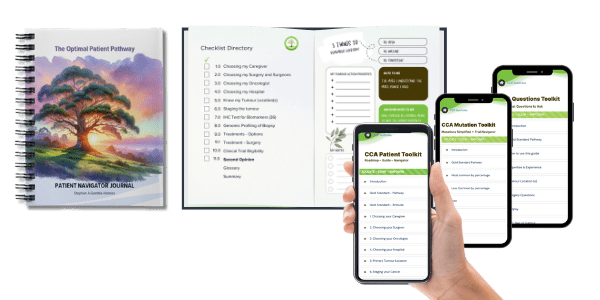
The Patient Navigator Journal
Cholangio.org builds the pathway.
The Patient Navigator Journal helps patients travel it.
This free guide helps patients and caregivers organise tests, track results, prepare questions and navigate cholangiocarcinoma step by step.
Download your free journal here: