
You have just lost someone
This is the pathway that helps you continue.
Start Here
These five steps help you understand what happened
so you know what to do next.
Take them one at a time.
Step 1. Enter the Pathway
Start by capturing what happened so it is not lost.
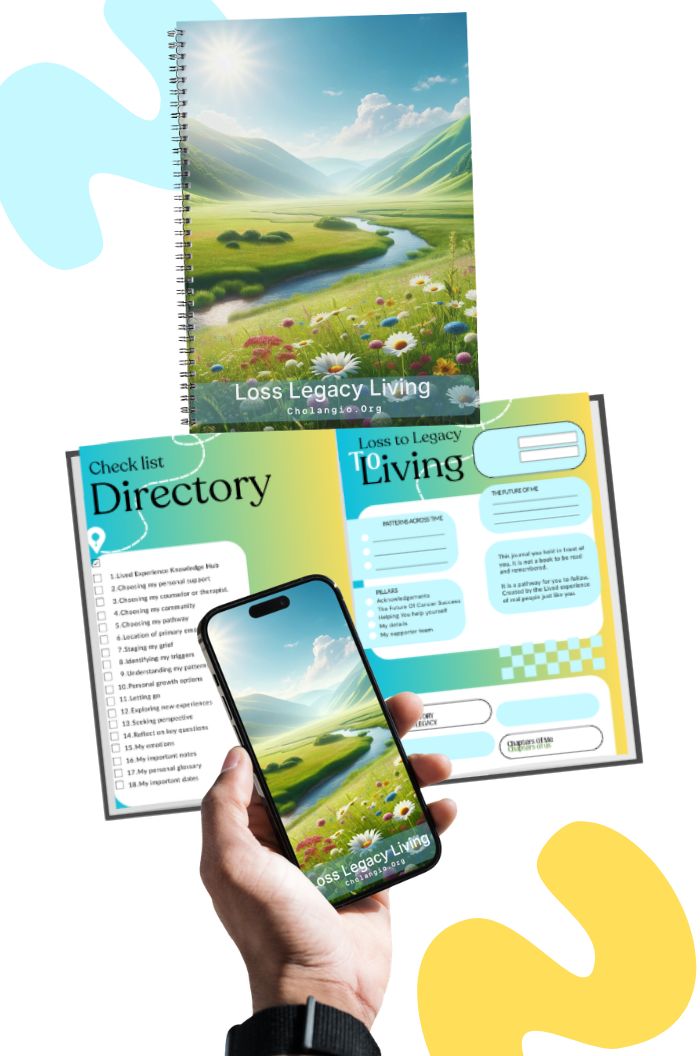
➤ Order Your Loss, Legacy & Living JournalStep 2. See the Pattern
Learn from lived experience from other journeys, so what happened becomes clearer.
Step 3. Understand The Cause
See what drives this cancer so it can be recognised earlier.
➤ Understand What Drives ItStep 4. Continue with Others
Join others carrying this forward so you do not do this alone.
Step 5. Carry Them Forward
Use what you have learned to help protect others’ options.
Join the early release list for the Loss, Legacy and Living Journal.
Email Jill or Claire to be included.
Cholangiocarcinoma
(ko-LAN-jee-oh-kar-sih-NOH-muh)
The word can feel unfamiliar at first.
Breaking it down makes it easier to understand.
- Chol means bile.
- Angio means duct or tract.
- Carcinoma means a cancer that begins in the protective tissue that lines the ducts.
You do not need to master this terminology today. You only need enough understanding to orient yourself and take the next step.
Think of the bile ducts as your liver’s plumbing system. They carry bile from the liver to the intestine.
In this case, the cancer has developed in the protective lining of these ducts. This lining is called the epithelial layer.
Bile is a chemical fluid produced by the liver.
It removes waste and toxins from the body.
But it also has a second, critical role.
Bile is produced continuously by the liver.
Instead of all flowing directly to the intestine, much of it is redirected into the gallbladder. The gallbladder acts as a storage chamber, holding and concentrating bile until it is needed.
When food enters the intestine, this stored bile is released back into the bile ducts, ready to be delivered.
Bile flows through the bile ducts to the first part of the intestine, the duodenum.
Think of the duodenum as a mixing chamber.
Food leaves the stomach as a thick paste called chyme. When it enters this chamber, it triggers three responses: the gallbladder releases bile, the pancreas releases digestive enzymes, and a control gate at the base of the bile ducts opens to allow both to enter.
They meet and combine as they enter the duodenum.
The enzymes break fats into smaller pieces.
Bile then reshapes those fat fragments.
It emulsifies them into tiny droplets, forming transport structures to carry essential nutrients across the intestinal wall and into the bloodstream.
These nutrients are then delivered throughout the body to support cellular function, resilience, and repair.
Without effective bile flow and composition, this transport system breaks down. Cells do not receive what they need to maintain their structure and stability.
As bile moves through the ducts, it remains in constant contact with the protective cells called cholangiocytes. These cells interlock to form the epithelial lining.
Every moment of every day, bile flows across this delicate surface on its journey downwards to the duodenum.
Think of this as a living surface made up of countless small “cell cities,” each one connected to the next.
Each of these cells is protected by a thin outer membrane.
Inside each cell is a nucleus, like a city hall.
It holds the city’s plans. Each page is a set of instructions, called genes, that control how the cell functions and repairs itself.
The cell’s thin outer membrane exists to protect these instructions.
It is here, at this constant contact point, that altered bile begins to stress and damage the epithelial lining. This is where cholangiocarcinoma begins.
Like all living tissue, this lining is designed to withstand normal conditions. But when those conditions change, both the lining and the flow of bile come under increased stress.
This creates two problems: increased friction and injury to the lining, and slowed bile flow, reducing its ability to reach the duodenum.
If you would like to discuss this further with Steve, email Jill or Claire to organise a time.
Protecting What Comes Next
What you have been through matters.
When it is understood, it can help someone else act earlier
and keep their options open.
This is how loss becomes something that lives on.
➤ Read: Mistakes That Quietly Cost Patients Their Best Chance